
At CES 2026, the smart stylus has moved beyond being a simple tablet accessory. It is now evolving into a spatial computing input terminal integrating AI handwriting recognition, 6DoF positioning, haptic feedback, edge processing, and ultra-low-latency wireless communication.
For product teams building next-generation smart pens, digital styluses, AI writing tools, and spatial input devices, battery design has become one of the most difficult engineering constraints.
A modern smart stylus typically weighs only 15g–20g, yet must deliver stable performance for pressure sensing, Bluetooth 6.0 or NearLink communication, vibration motors, and continuous edge AI handwriting processing.
This creates a familiar challenge for OEM engineers: How do you fit an efficient rechargeable battery pack into a pen body only a few millimeters wide without compromising center-of-gravity balance?
The Core Battery Challenges of Smart Stylus Design
| Engineering Requirement | Battery Constraint | Recommended Solution |
|---|---|---|
| Ultra-lightweight form factor | Limited internal space | 80mAh–150mAh needle-shaped LiPo |
| Low latency haptic feedback | Pulse current demand | High-rate 3.85V / 4.48V polymer cell |
| Long standby performance | Self-discharge control | Low-leakage custom PCM |
| Balanced center of gravity | Uneven weight distribution | Custom elongated pouch battery |
| Fast recharge | Thermal limitations | GaN-compatible fast charge architecture |
Why Conventional Coin Cells No Longer Work
Older smart pen products often relied on disposable alkaline cells or simple low-capacity lithium cells. That approach becomes insufficient when supporting:
- AI handwriting recognition
- Real-time pressure sampling
- Spatial gesture tracking
- 6DoF motion sensing
- Micro haptic vibration motors
- Bluetooth 6.0 / NearLink continuous connection
Battery systems now require optimized rechargeable lithium polymer battery packs in voltages such as 3.7V, 3.8V, 3.85V, 3.87V, 3.88V, 7.4V, depending on architecture.
MOTOMA Smart Stylus Battery Design Solutions
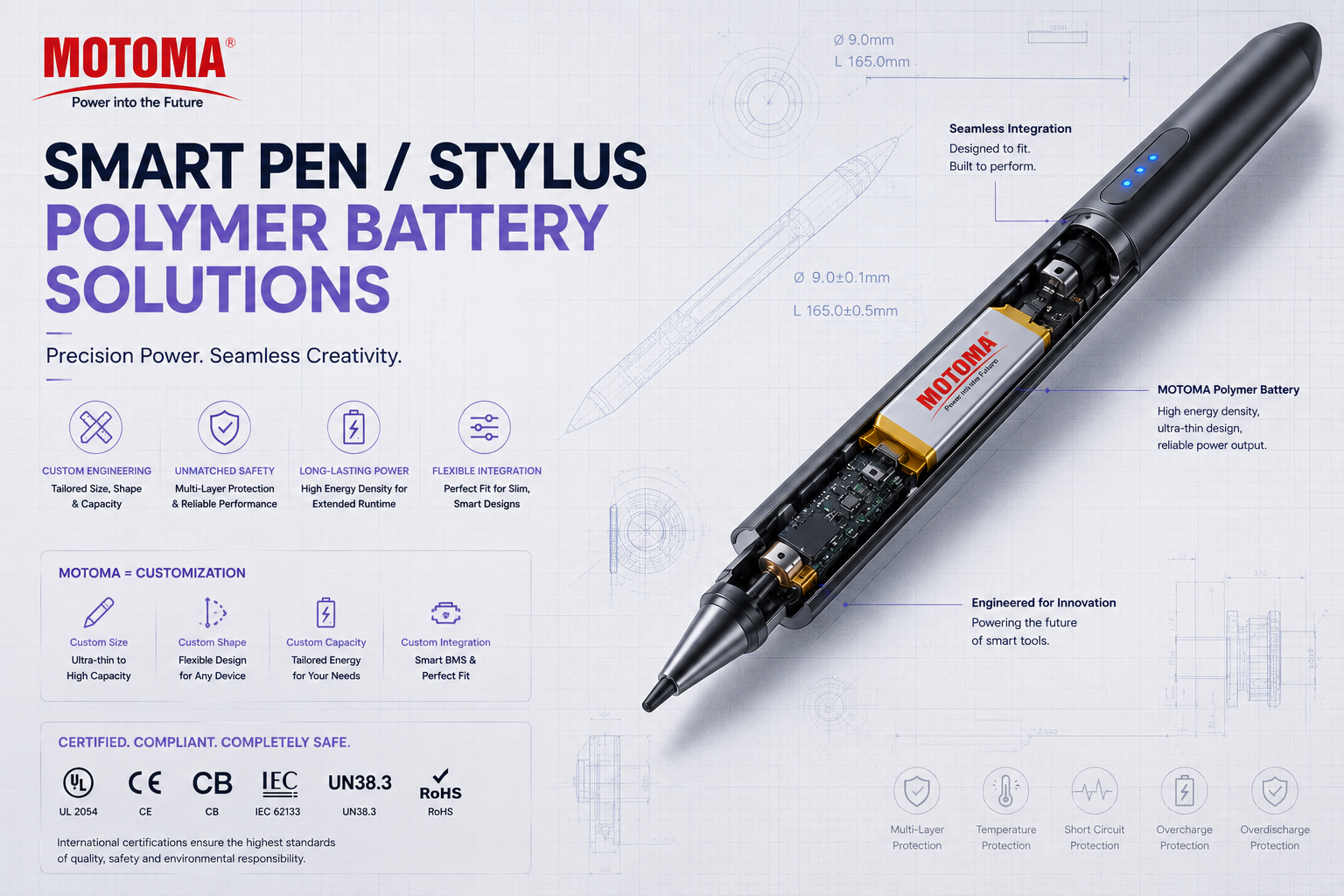
1. Needle-Shaped Silicon-Carbon Polymer Battery
For narrow stylus barrel integration, MOTOMA provides ultra-slim custom pouch cells designed for pen-type electronics.
| Capacity | Voltage | Application |
|---|---|---|
| 80mAh | 3.7V | Basic Bluetooth stylus |
| 100mAh | 3.85V | Pressure-sensitive smart pen |
| 120mAh | 3.88V | Magnetic charging stylus |
| 150mAh | 4.48V | AI-enabled stylus with haptics |
| 250mAh | 7.4V | Hybrid recording smart pen |
Compared with standard cylindrical cells, custom polymer pouch batteries improve volumetric utilization by 20–30%.
2. Fast-Charge Optimization
Modern users expect immediate usability. A depleted stylus should not interrupt workflow.
MOTOMA battery systems support:
- 30-second emergency top-up
- 1-minute charge for 1-hour writing
- 10-minute full recharge
- Magnetic wireless charging integration
3. Dynamic Discharge Stability
Haptic feedback and pressure-sensitive rendering create rapid transient current demands. Stable voltage delivery is critical for maintaining sub-1ms latency.
Our optimized high-rate LiPo cells support:
- 5C pulse discharge
- Low internal resistance
- Minimal voltage sag
Battery Recommendations by Smart Stylus Product Type
| Device Type | Battery Spec | Typical Runtime |
|---|---|---|
| Basic Smart Pen | 80mAh 3.7V | 8–10h |
| Tablet Stylus | 100mAh 3.85V | 10–12h |
| AI Stylus | 150mAh 4.48V | 15–20h |
| Voice Recording Pen | 250mAh 7.4V | 5–8h continuous |
| Professional Creative Stylus | 180mAh 3.88V | 18–20h |
Safety Matters for Handheld Writing Devices
Stylus batteries operate in direct contact with users. Thermal safety is non-negotiable.
MOTOMA custom smart pen battery packs include:
- Ceramic-coated separator technology
- Overcharge / overcurrent protection
- Ultra-low thermal expansion materials
- Reinforced pouch sealing
This is particularly important for premium consumer electronics where the pen is often carried in pockets or bags under compression.
Engineering Perspective: Why Customization Matters
Off-the-shelf batteries rarely satisfy stylus product design requirements.
OEM customization allows:
- Precise battery diameter control
- Length optimization
- Connector customization
- PCM tuning
- Weight balancing for writing comfort
FAQ
1. What battery capacity is ideal for a smart stylus?
Typically 80mAh to 150mAh depending on wireless features and haptic feedback requirements.
2. Is 3.85V better than 3.7V for stylus devices?
Yes. 3.85V high-voltage chemistry offers higher energy density within the same footprint.
3. Can smart pens support wireless charging?
Yes, with properly integrated magnetic receiver coil architecture.
4. Why choose polymer pouch batteries over cylindrical cells?
They offer better internal space utilization and flexible shaping.
5. How long can a custom stylus battery last?
Typically 500–800 cycles depending on charging profile.
6. Does MOTOMA support OEM stylus battery projects?
Yes. We provide fully customized lithium polymer battery design for smart pen and digital stylus applications.