
At CES 2026, smart locks shifted from simple access control devices into integrated home security terminals. With 3D face recognition, palm-vein authentication, UWB hands-free unlocking, edge AI anomaly detection, and Matter 1.5 ecosystem integration becoming mainstream, power demand has moved well beyond what traditional AA alkaline cells can support.
For electronic product developers, this creates a practical engineering challenge: how to fit 5000mAh, 7500mAh, 10000mAh, or even 15000mAh lithium power systems inside a compact lock chassis while maintaining thermal stability, cycle life, and standby performance.
The Power Bottleneck in Next-Generation Smart Locks
| Feature | Power Requirement | Battery Challenge |
|---|---|---|
| 3D Face Recognition | High burst current | Voltage sag risk |
| UWB Unlocking | Always-on low-power sensing | Standby drain |
| Auto Lock Motor | Instant discharge peak | High-rate output stability |
| 2K Security Camera | Continuous recording | Thermal accumulation |
| Matter / Wi-Fi Connectivity | Persistent communication | Long-term cycle degradation |
This is why product teams are moving from disposable cells to custom lithium polymer battery packs using 3.7V, 3.8V, 3.85V, 3.87V, 3.88V, 7.4V and 11.1V architectures.
MOTOMA Battery Solution for AI Smart Locks
1. High-Energy-Density Silicon-Carbon Polymer Cells
For compact smart lock internal panels, volumetric efficiency matters. MOTOMA custom lithium pouch cells leverage high-density chemistry to support:
- 5000mAh for entry-level camera locks
- 7500mAh for UWB + biometric systems
- 10000mAh for AI face recognition locks
- 12000mAh–15000mAh for full security hub platforms
These are available in 3.85V high-voltage LiPo, 7.4V dual-cell battery pack, and 11.1V triple-cell configurations.
2. Dual-Power Redundancy Design
A modern smart lock cannot simply shut down. Recommended architecture:
- Main rechargeable lithium polymer pack
- Emergency backup battery (800mAh–1000mAh)
- USB-C emergency charging interface
This design ensures unlock continuity even when primary battery reaches critical threshold.
3. High Pulse Discharge Stability
Motorized locking systems require stable burst current. MOTOMA supports:
- 5C continuous discharge
- 10C pulse discharge
- Low internal resistance pouch architecture
Critical for auto-open and anti-jam mechanisms.
Recommended Battery Specifications by Lock Category
| Smart Lock Type | Battery Spec | Voltage | Runtime |
|---|---|---|---|
| Basic Fingerprint Lock | 5000mAh | 3.7V | 6–8 months |
| Face Recognition Lock | 7500mAh | 3.85V | 8–10 months |
| UWB Smart Lock | 10000mAh | 7.4V | 10–12 months |
| AI Security Lock Hub | 12000–15000mAh | 11.1V | 12+ months |
Thermal Safety for Door-Mounted Electronics
Unlike indoor handheld electronics, smart locks face:
- Direct sunlight exposure
- Outdoor humidity
- Winter low-temperature operation
- Mechanical shock during forced entry attempts
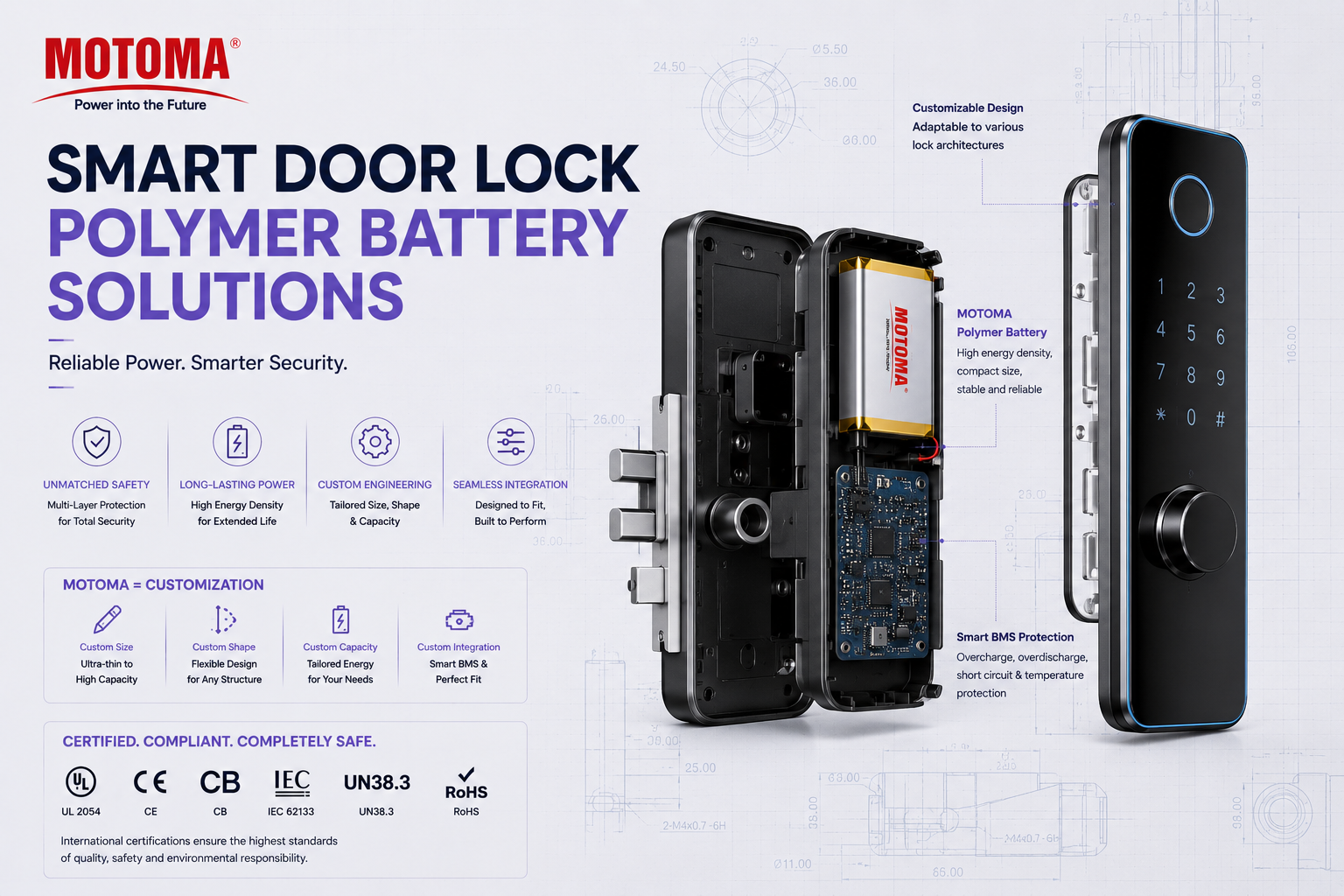
MOTOMA smart lock battery packs integrate:
- Ceramic-coated separators
- Multi-layer protection PCB
- Wide-temperature electrolyte system
- Mechanical anti-puncture reinforcement
Why Custom Battery Design Matters
Off-the-shelf batteries rarely fit advanced smart lock industrial design. Custom battery engineering enables:
- Curved pouch formats
- Ultra-thin side-panel integration
- Balanced weight distribution
- Optimized thermal path design
FAQ
1. What battery voltage is best for smart locks?
3.85V is common for compact systems; 7.4V suits high-performance AI locks.
2. How much battery capacity does face recognition require?
Typically 7500mAh to 10000mAh for practical 6–12 month deployment.
3. Can lithium polymer batteries replace AA cells?
Yes, with proper BMS and charging architecture.
4. Is custom battery shape necessary?
For slim industrial designs, yes. It improves internal space utilization.
5. How many cycles can these battery packs deliver?
Generally 800–1200 cycles depending on charging profile and operating temperature.
6. Does MOTOMA support OEM battery customization?
Yes. Cell size, voltage, connector, PCM, and housing integration can all be customized.