
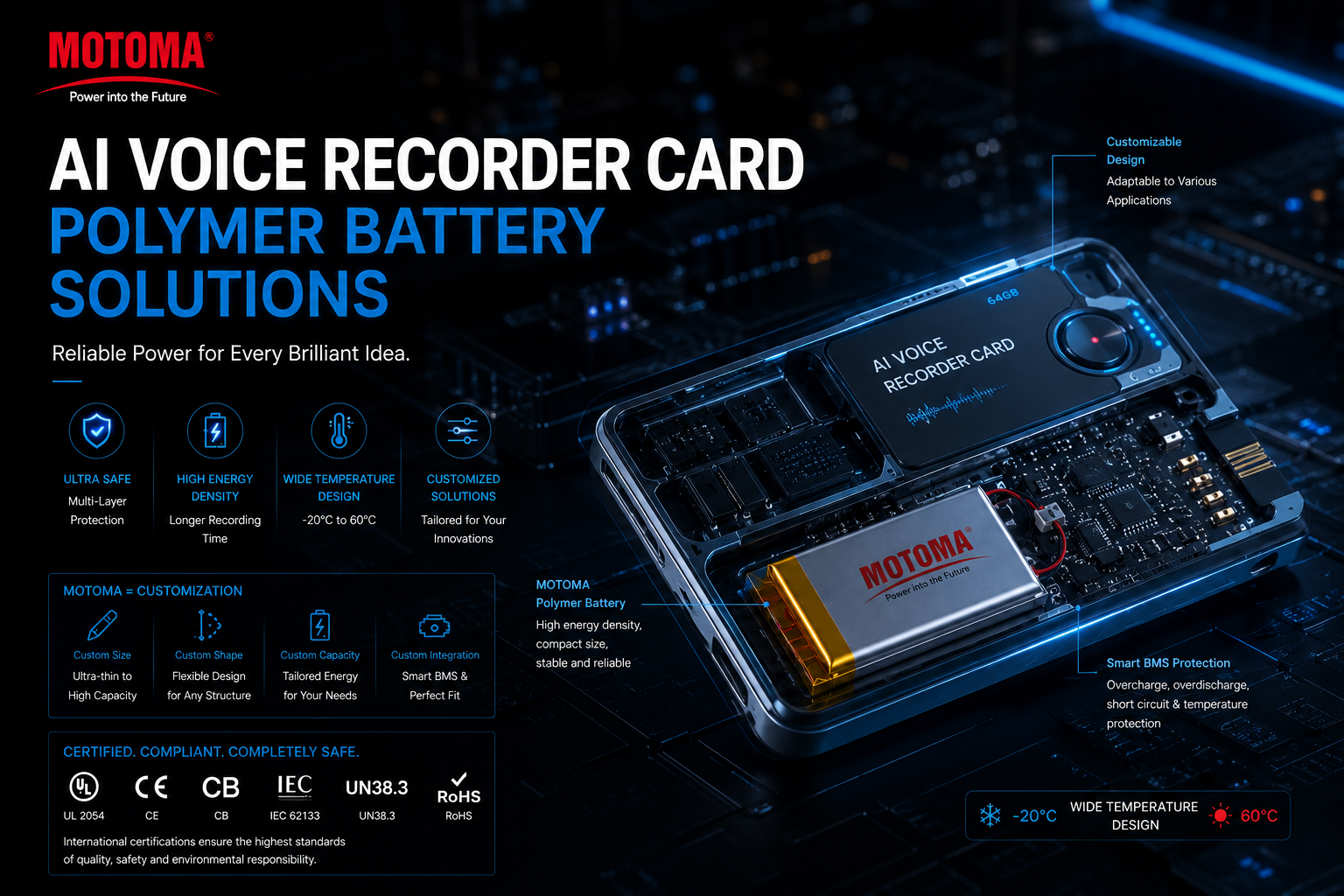
At CES 2026, one product category quietly attracted strong interest from business electronics developers, educational technology manufacturers, and embedded AI solution providers: the AI voice recorder card.
Products positioned as digital memory assistants are rapidly evolving from simple recording devices into edge-AI productivity hardware capable of:
- Real-time transcription
- Local speech processing
- Multi-language summarization
- Wi-Fi cloud synchronization
- Ultra-low standby voice detection
The engineering challenge is straightforward but demanding: how do you fit enough power into a device no thicker than a credit card?
For battery designers, this has become one of the most interesting lithium polymer application scenarios in consumer electronics. Across CES 2026, the dominant solution direction was clear: custom ultra-thin lithium polymer battery packs using 3.7V, 3.8V, 3.85V, 3.87V, 3.88V and increasingly 4.48V high-voltage pouch cell platforms.
Why AI Recorder Cards Create Unique Battery Constraints
Unlike standard portable electronics, AI voice recorder cards combine extremely thin industrial design with burst transmission workloads.
| Design Constraint | Battery Engineering Challenge |
|---|---|
| 2.5mm–3mm total product thickness | Requires ultra-thin stacked lithium polymer cells |
| Always-listening standby | Demands microamp-level idle current |
| Wi-Fi upload bursts | Requires stable high-current discharge |
| Large file synchronization | Needs low internal resistance |
| Pocket thermal exposure | Requires enhanced heat management |
Traditional rolled lithium-ion cells simply cannot provide sufficient geometry flexibility for these products. Ultra-thin pouch cells are now the preferred architecture.
Battery Technology Trends from CES 2026
1. Ultra-Thin Stacked Polymer Cells
Manufacturers are increasingly moving away from winding processes toward advanced stacked-cell structures.
Typical specifications include:
- 200mAh for ultra-minimal note cards
- 400mAh–500mAh for standard AI transcription cards
- 600mAh–800mAh for premium edge-AI recorder systems
- 1000mAh for display-integrated professional recording platforms
Cell thickness can now reach:
- 0.8mm
- 1.2mm
- 1.5mm
This makes true card-thickness devices commercially practical.
2. High-Voltage Lithium Polymer Platforms
Several 2026 recorder card designs are shifting toward 4.48V high-voltage chemistry. Compared with standard 4.2V charging systems, this enables:
- Higher energy density
- Longer continuous recording runtime
- Better burst transmission support
Typical battery configurations include:
| Voltage | Typical Application |
|---|---|
| 3.7V | Entry-level recorder cards |
| 3.8V / 3.85V | Mainstream AI voice recorders |
| 3.87V / 3.88V | Extended-runtime edge-AI devices |
| 4.48V | High-efficiency premium transcription hardware |
| 7.4V | Dual-cell advanced meeting recorder systems |
| 11.1V / 14.8V | Docking-based enterprise transcription modules |
Power Optimization Is Becoming More Important Than Capacity Alone
Interestingly, CES 2026 showed that bigger batteries are not always the answer.
A well-optimized 500mAh 3.85V lithium polymer battery can outperform a poorly managed 800mAh design.
The difference comes from intelligent power management:
- Voice-triggered wake systems
- Neural VAD activation
- Selective memory power-up
- Adaptive wireless synchronization scheduling
This is allowing recorder cards with 400mAh–600mAh batteries to achieve:
- 30–50 hours continuous recording
- 60–90 days standby
Typical Battery Specifications for 2026 AI Voice Recorder Cards
| Product Type | Capacity | Voltage | Battery Thickness | Runtime |
|---|---|---|---|---|
| Ultra-Slim Recorder Card | 200mAh–320mAh | 3.7V | 0.8–1.0mm | 12–20h |
| Business Meeting Recorder | 400mAh–500mAh | 3.85V | 1.1–1.3mm | 30–40h |
| AI Transcription Card | 600mAh | 3.88V / 4.48V | 1.5mm | 40–50h |
| Premium Enterprise Recorder | 800mAh–1000mAh | 7.4V | 2.0–2.5mm | 50h+ |
MOTOMA‘s Engineering Approach for Ultra-Thin Battery Development
Battery development for AI voice recorder cards requires more than shrinking existing cells.
The engineering process must account for:
- PCB layout clearance
- MEMS microphone placement
- Wireless charging coil positioning
- Thermal dissipation path
- Peak Wi-Fi transmission current
At MOTOMA, custom lithium polymer battery solutions for AI productivity devices include:
- 3.7V 200mAh ultra-thin pouch cells
- 3.85V 500mAh stacked batteries
- 4.48V 600mAh high-voltage polymer packs
- 7.4V dual-cell enterprise modules
The objective is always practical: maximize runtime without compromising industrial design.
Frequently Asked Questions
Q1: Why are recorder cards shifting to 3.85V batteries?
They offer higher usable energy density in thin form factors.
Q2: What battery capacity is most common?
400mAh–600mAh is currently the mainstream range.
Q3: Can ultra-thin batteries support Wi-Fi burst uploads?
Yes, if internal resistance is optimized through stacked-cell construction.
Q4: Is wireless charging practical for recorder cards?
Magnetic wireless charging is increasingly common for slim productivity devices.
Q5: What thickness is achievable?
Commercial lithium polymer cells can now reach below 1.0mm.
Q6: How important is thermal control?
Very important, especially when the device is carried in pockets or attached to phones.