
CES 2026 made one thing very clear: smart glasses are moving beyond accessory status. They are gradually becoming standalone computing terminals capable of AI interaction, live translation, contextual display overlays, video capture, and independent eSIM communication.
For hardware teams, this creates a familiar engineering contradiction: how do you fit more power into less than 5mm of usable internal space while maintaining comfort, thermal stability, and weight balance?
For product managers and design engineers, battery selection is no longer a late-stage sourcing decision. It now directly impacts:
- Frame structure design
- Thermal pathway planning
- User comfort
- Display runtime
- Wireless communication stability
- Product certification pathways
The New Battery Demands of AI Smart Glasses
| Application | Typical Battery Range | Voltage Platform | Core Requirement |
|---|---|---|---|
| Audio AI Glasses | 300mAh–500mAh | 3.7V / 3.8V | Low standby drain |
| AR Display Glasses | 600mAh–900mAh | 3.85V / 3.87V | Stable continuous discharge |
| eSIM Smart Glasses | 800mAh–1200mAh | 3.88V / 4.35V | High pulse transmission current |
| Industrial Smart Eyewear | 1000mAh–2000mAh | 7.4V dual-cell | Extended runtime |
Why Custom Polymer Batteries Are Replacing Standard Cells
Traditional cylindrical cells were never designed for eyewear geometry. Even ultra-small lithium-ion cells introduce:
- Poor weight distribution
- Limited design freedom
- Hotspot concentration
- Frame bulkiness
Custom lithium polymer pouch cells solve this through flexible structural adaptation.
1. Dual-Temple Balanced Battery Architecture
Instead of placing a 1000mAh battery pack on one side, manufacturers are increasingly using:
- 2 × 450mAh 3.85V cells
- 2 × 500mAh 3.88V cells
- Distributed 7.4V split battery systems
This reduces nose bridge pressure and improves long-term wearability.
2. High Voltage Platforms for Better Efficiency
Modern smart eyewear increasingly uses:
- 3.85V lithium polymer battery
- 3.87V LiPo battery pack
- 3.88V high-density pouch cell
Compared to conventional 3.7V batteries, these deliver more usable energy without enlarging battery footprint.
3. Ultra-Thin Custom Profiles
Typical MOTOMA smart glasses battery designs include:
| Capacity | Voltage | Thickness | Use Case |
|---|---|---|---|
| 100mAh | 3.7V | 1.2mm | Gesture sensors |
| 300mAh | 3.8V | 2.0mm | Audio glasses |
| 500mAh | 3.85V | 2.5mm | AI voice glasses |
| 800mAh | 3.88V | 3.0mm | AR smart glasses |
| 1000mAh | 7.4V | Custom split-cell | Industrial AR |
Thermal Stability Is No Longer Optional
Micro-LED display engines, Wi-Fi 7 modules, and edge AI chips create localized thermal pressure. Battery packs must therefore integrate:
- Graphene thermal layers
- Ceramic-coated separators
- Semi-solid electrolyte options
- Low internal resistance chemistry
This ensures stable discharge under high-load conditions such as:
- Real-time translation
- 4K recording
- Navigation overlays
- Continuous voice assistant operation
Fast Charging Expectations in 2026
Users now expect:
- 10-minute top-up
- Wireless magnetic charging
- Charging-case ecosystem integration
Common battery configurations:
- 3.85V 500mAh with 2C charge
- 3.88V 800mAh with magnetic dock charging
- 7.4V dual-cell pack with fast balancing BMS
Engineering Considerations When Designing Smart Glasses Batteries
Before selecting a battery, hardware teams should define:
- Total frame cavity dimensions
- Allowable weight per temple
- Peak current draw
- Expected charging method
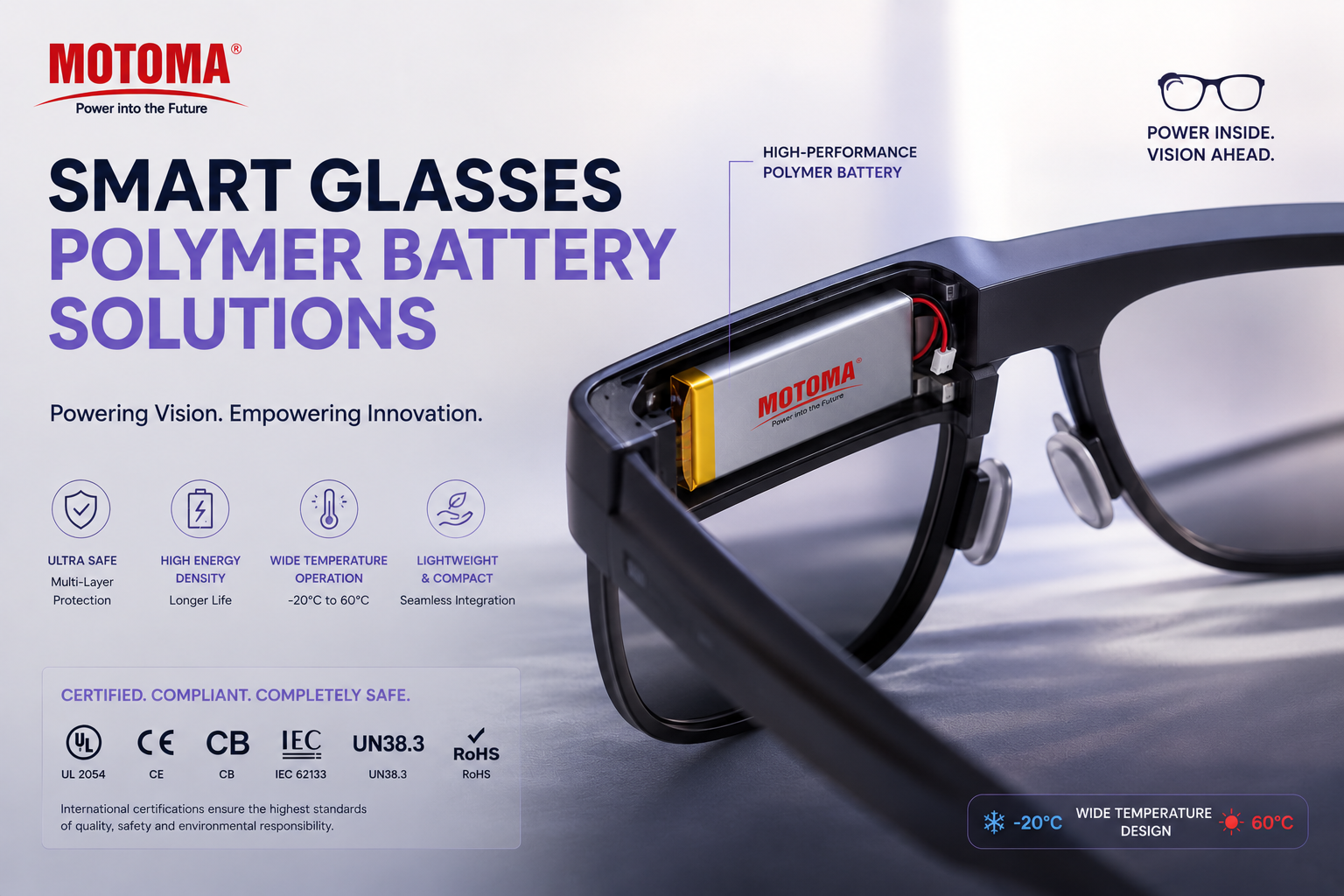
- Certification target (UL2054 / IEC62133 / UN38.3)
How MOTOMA Supports Smart Eyewear Development
MOTOMA works with OEM and ODM teams to develop custom lithium polymer battery solutions for:
- AR glasses
- AI smart eyewear
- Audio glasses
- Industrial vision systems
- Prescription smart glasses
Available customization:
- 3.7V / 3.8V / 3.85V / 3.87V / 3.88V / 7.4V / 11.1V / 14.8V
- 100mAh to 5000mAh
- Curved / split / ultra-thin profiles
- PCM / smart fuel gauge integration
Frequently Asked Questions
Q1: Why use 3.85V instead of 3.7V for smart glasses?
Higher energy density without increasing size.
Q2: Can polymer batteries be curved for eyewear?
Yes. Custom curved pouch cells are increasingly common.
Q3: What is typical smart glasses battery capacity?
300mAh to 1000mAh depending on functionality.
Q4: Is 7.4V practical for AR glasses?
Yes, especially for industrial or high-display-load applications.
Q5: What matters most: capacity or balance?
For eyewear, weight distribution usually matters more than raw capacity.