
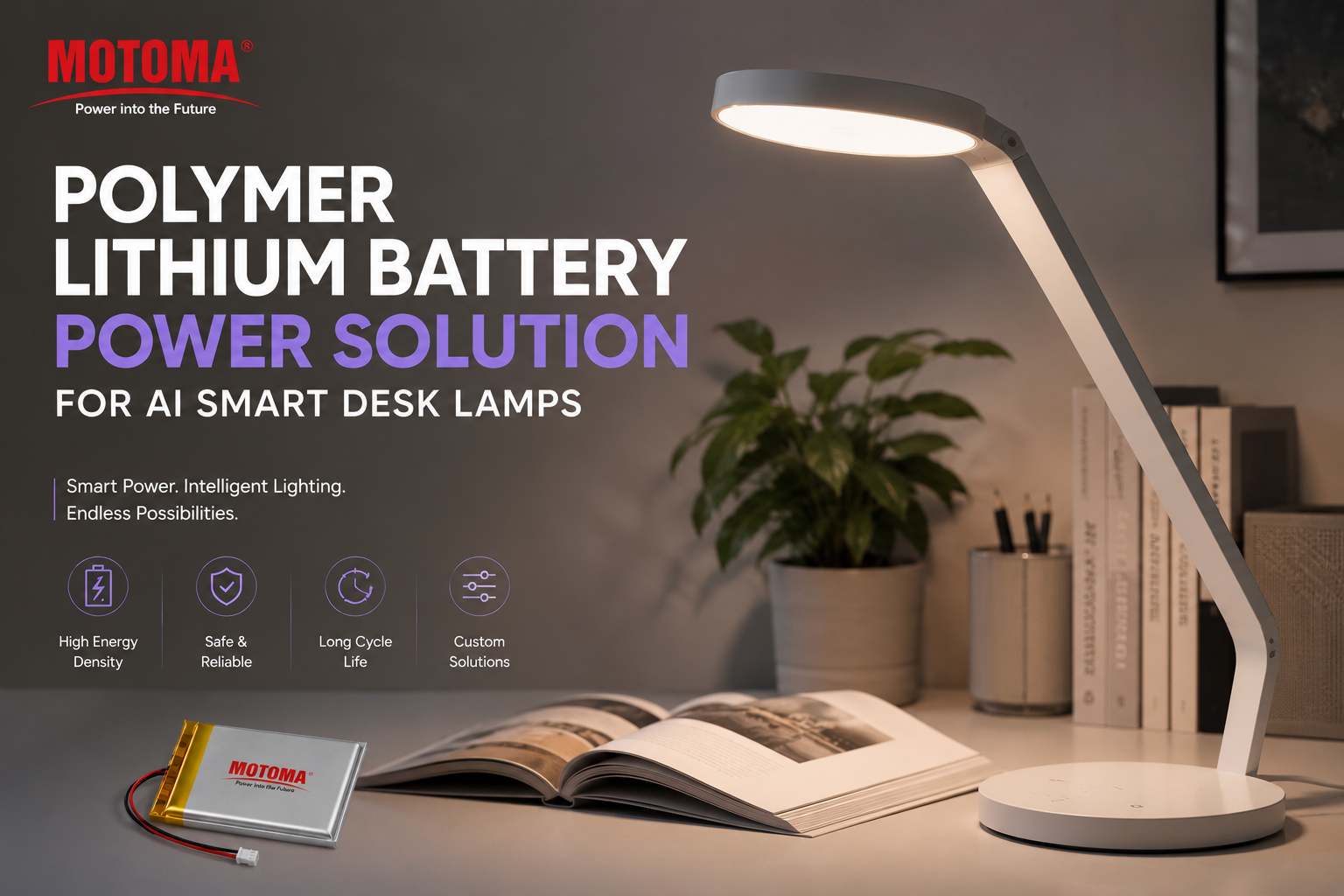
At CES 2026, smart desk lamps have evolved from single-purpose lighting products into a Physical AI hub within the home. Driven by trends such as AI-in-home deployment, spatial awareness, and sustainable energy, modern desk lamps are no longer fully dependent on power cords. High-performance polymer lithium batteries now enable wireless operation, mobility, and emergency readiness.
1. Core Power Architecture: High-Capacity, High-Voltage Polymer Systems
Compared with conventional LED lamps, 2026 smart desk lamps integrate AI voice assistants, ultrasonic gesture recognition, and circadian lighting control, significantly increasing overall power demand.
- High-Voltage (4.45V) Stacked Polymer Cells:
To meet CES 2026 expectations for slim form factors and space efficiency, high-voltage polymer systems are adopted. With energy density exceeding 300 Wh/kg, lamp bases can remain elegant and compact while integrating up to 10,000 mAh of capacity. This supports up to 8 hours of full-brightness lighting during power outages, or one month of low-brightness standby. - Hybrid Power Path Management:
Smart desk lamps support seamless switching between mains power and battery operation. When electricity pricing peaks—coordinated through Matter-based smart grid integration— the system prioritizes stored battery energy, enabling AI-driven household energy optimization.
2. Energy Replenishment: Magnetic Ecosystems and Ambient Energy Harvesting
- Magnetic Charging Interface:
Inspired by magnetic ecosystems demonstrated by some brands at CES 2026, traditional DC jacks are replaced by magnetic contact charging. Users can freely move the lamp from a desk to a terrace or bedside, and charging automatically resumes when the lamp returns to its base. - Photovoltaic Self-Charging Coating:
Thin-film polymer solar coatings are integrated into the top of the lamp head. Even when the lamp is switched off, indoor daylight or ambient lighting provides microwatt-level charging, ensuring that always-on AI sensors—such as voice wake-word detection—remain powered.
3. Intelligent Management: AI Battery Health Stewardship
- Circadian-Aware Discharge Scheduling:
AI algorithms align battery usage with the user’s daily rhythm. For example, during detected deep-focus work periods, the system limits discharge depth to preserve long-term battery health. - Thermal-Adaptive Protection:
As LED light sources generate heat, the battery management system (BMS) continuously monitors temperature via embedded sensors. If thermal conditions approach battery stress thresholds, the AI dynamically reduces LED drive current, keeping the battery within its optimal 25°C–35°C operating range.
4. Typical Battery Specifications for CES 2026 Smart Desk Lamps
Based on representative smart lighting products showcased at CES 2026, including Tuya AI desk lamps and Govee ambient light towers, the following configurations reflect common design benchmarks:
| Product Category | Typical Capacity | Battery Voltage / Type | Runtime Performance | Key Technology Focus |
|---|---|---|---|---|
| AI Eye-Care Study Lamp | 10,000 mAh | 3.85V stacked polymer | 8h high brightness / 48h energy-saving | Silicon-carbon anode, high energy density |
| Portable Ambient Desk Lamp | 5,200 mAh | 3.7V custom-shaped polymer | 12h lighting + audio | Hidden magnetic charging, slim design |
| Emergency AI Backup Lamp | 2,500 mAh | 4.45V high-voltage system | 180 days emergency standby | Low self-discharge, instant-on readiness |
| Multi-Display Smart Desk Lamp | 15,000 mAh | 7.4V (2S) power battery | Lighting + display + AI processing | Integrated 65W GaN fast charging |
5. 2026 Design Summary: From Accessory to Energy Base
- Form Factor Innovation: Polymer batteries are no longer heavy base weights. Ultra-thin packaging allows cells to be hidden within lamp arms or heads, improving balance and supporting minimalist industrial design.
- Sustainability and Circular Design: In line with CES 2026’s green technology focus, battery packs adopt modular, easy-to-remove designs that support recycling and reduce electronic waste.