
CES 2026 highlighted a noticeable shift in smart cleaning devices. Robot vacuums and cordless handheld vacuum cleaners are no longer defined only by suction power or runtime. The conversation has moved toward physical AI, embodied intelligence, robotic interaction, and autonomous environmental decision-making.
With flagship systems now integrating:
- 30,000Pa+ suction motors
- Retractable robotic arms
- Wheel-leg hybrid mobility systems
- Multi-sensor AI navigation
- Real-time adaptive power management
Battery engineering has become one of the primary design constraints. For product engineers and OEM manufacturers, battery selection now directly affects structural design, thermal performance, cleaning efficiency, and intelligent task execution.
Why Traditional Vacuum Battery Systems Are Reaching Their Limits
Conventional cylindrical lithium-ion battery packs were originally designed for relatively predictable discharge profiles. Modern AI-enabled cleaning systems present a very different load pattern.
| Operating Scenario | Battery Requirement |
|---|---|
| Turbo suction activation | 5C–10C pulse discharge |
| Obstacle climbing / wheel-leg motion | Stable high-current delivery |
| AI computation + LiDAR scanning | Low-ripple voltage stability |
| Fast charging dock cycles | High-rate charge acceptance |
This is why many next-generation products are moving toward custom lithium polymer battery packs using 3.7V, 3.8V, 3.85V, 3.87V, 3.88V, 7.4V, 11.1V, and 14.8V configurations.
Recommended Battery Architectures for Smart Vacuum Systems
| Product Category | Voltage | Capacity | Discharge Rate | Battery Structure |
|---|---|---|---|---|
| Compact Robot Vacuum | 7.4V | 5200mAh–6400mAh | 5C | Ultra-thin flat pack |
| Premium Robot Cleaner | 11.1V | 6400mAh–8000mAh | 8C | L-shaped custom pack |
| Cordless Handheld Vacuum | 14.8V | 4000mAh–5000mAh | 10C–15C | Modular high-rate polymer |
| AI Cleaning Station System | 14.8V | 8000mAh–10000mAh | 8C | Distributed structural battery |
Silicon-Carbon Polymer Cells Are Changing Runtime Expectations
One of the most visible trends at CES 2026 was the use of silicon-carbon anode lithium polymer cells.
Compared with earlier graphite-based battery systems, these cells offer:
- Higher energy density (350–380Wh/kg)
- Better packaging efficiency
- Improved fast-charge performance
- Higher usable capacity in thin structures
For example:
- 5200mAh 7.4V for ultra-thin robotic cleaners
- 6400mAh 11.1V for AI obstacle-climbing systems
- 8000mAh 14.8V for full-home autonomous cleaning platforms
This capacity increase directly supports longer cleaning sessions without increasing chassis thickness.
High Discharge Matters More Than Raw Capacity
Suction motors create sharp current spikes, especially when AI detects carpets or heavy debris.
A battery pack may have sufficient nominal capacity, but if it cannot sustain stable output during sudden 8C–10C bursts, cleaning performance drops immediately.
Typical discharge requirements:
| Cleaning Mode | Required Discharge |
|---|---|
| Eco mode | 1C–2C |
| Standard cleaning | 3C–5C |
| Turbo suction | 8C |
| Carpet boost / obstacle lift | 10C–15C pulse |
This is where high-rate custom LiPo battery packs provide measurable operational advantages.
Thermal Safety in Wet-Cleaning Applications
Vacuum cleaners increasingly integrate wet-cleaning and heated water floor washing. This introduces a new engineering challenge: heat and moisture exposure.
Battery systems for these products must tolerate:
- High humidity operation
- Localized thermal zones
- Repeated charging dock heat accumulation
- Mechanical shock during movement
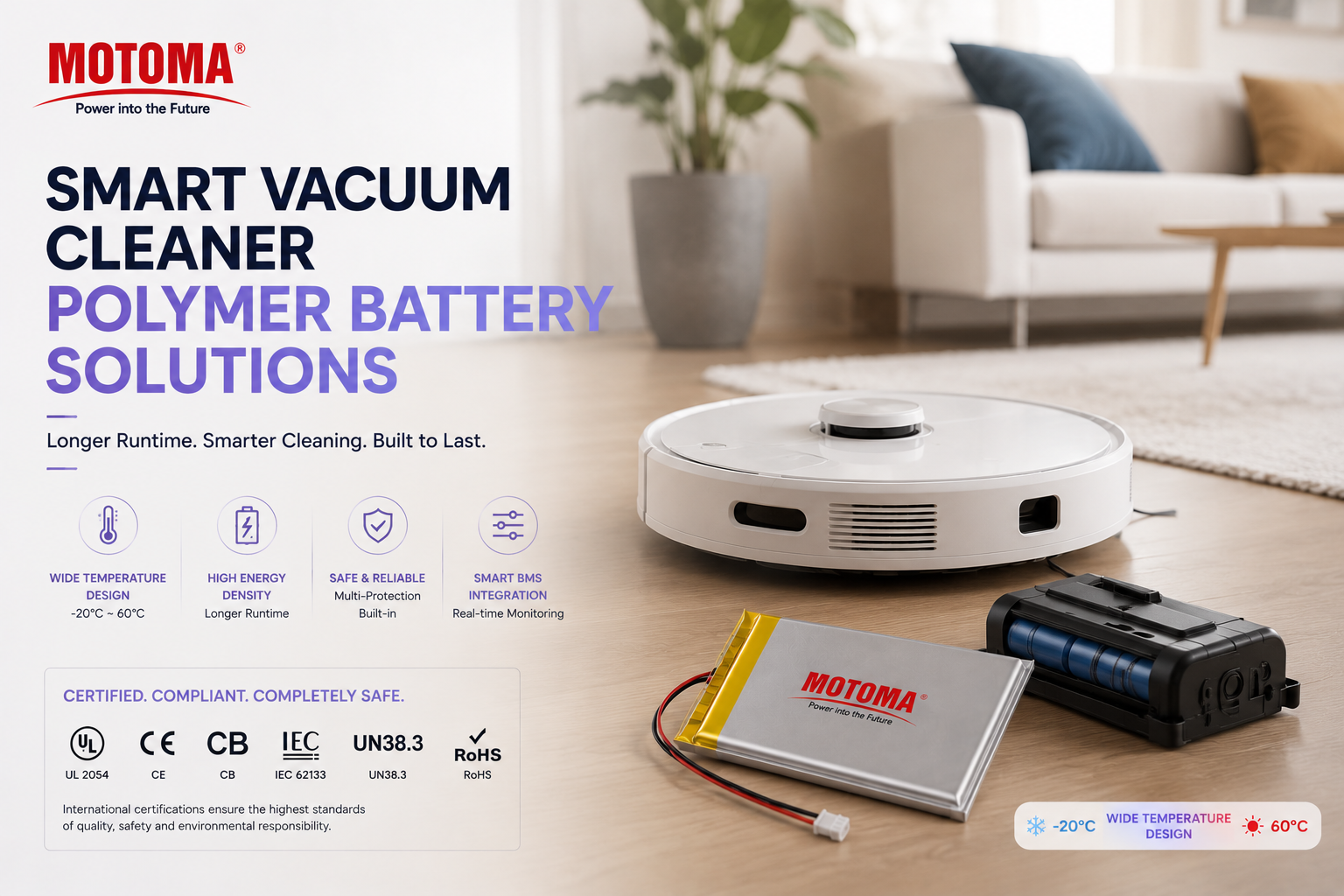
MOTOMA battery systems integrate:
- Ceramic-coated separators
- Multi-layer thermal shielding
- NTC-based thermal sensing
- Adaptive balancing algorithms
This allows battery core temperature to remain controlled even when external chassis zones reach elevated temperatures.
Fast Charging Is Becoming a Product-Level Requirement
Consumers increasingly expect cleaning devices to recharge quickly between sessions.
Emerging standards now include:
| Charging Method | Power | Battery Compatibility |
|---|---|---|
| Dock charging | 45W | 7.4V systems |
| GaN integrated charging | 65W–100W | 11.1V / 14.8V |
| Magnetic quick-swap charging | 120W | Modular handheld packs |
Fast-charge capable chemistries such as 3.87V and 3.88V lithium polymer cells are becoming increasingly relevant in this category.
Battery Shape Is Now a Mechanical Design Variable
Modern robot vacuum design prioritizes lower profile structures and improved mobility.
This has driven increased use of:
- L-shaped battery packs
- Curved structural battery modules
- Ring-layout polymer battery systems
- Distributed compartmental battery design
Custom battery geometry helps product teams maximize internal volume utilization while preserving airflow and motor placement.
Engineering Considerations for Product Teams
When selecting battery solutions for smart cleaning devices, engineering teams should evaluate:
- Peak discharge stability
- Thermal resistance under sustained load
- Charging cycle stress profile
- Mechanical integration flexibility
- BMS-to-AI communication compatibility
Final Engineering Perspective
CES 2026 confirmed that smart vacuum cleaner development is moving beyond suction specifications. Battery systems are becoming active contributors to AI performance, runtime optimization, and product intelligence.
For manufacturers developing robot vacuums, handheld cleaners, and autonomous cleaning platforms, choosing the right custom 3.7V, 7.4V, 11.1V, or 14.8V lithium polymer battery pack is now a core system architecture decision.
MOTOMA focuses on custom LiPo battery engineering designed around real product constraints—balancing discharge performance, structural integration, thermal safety, and intelligent energy management.