
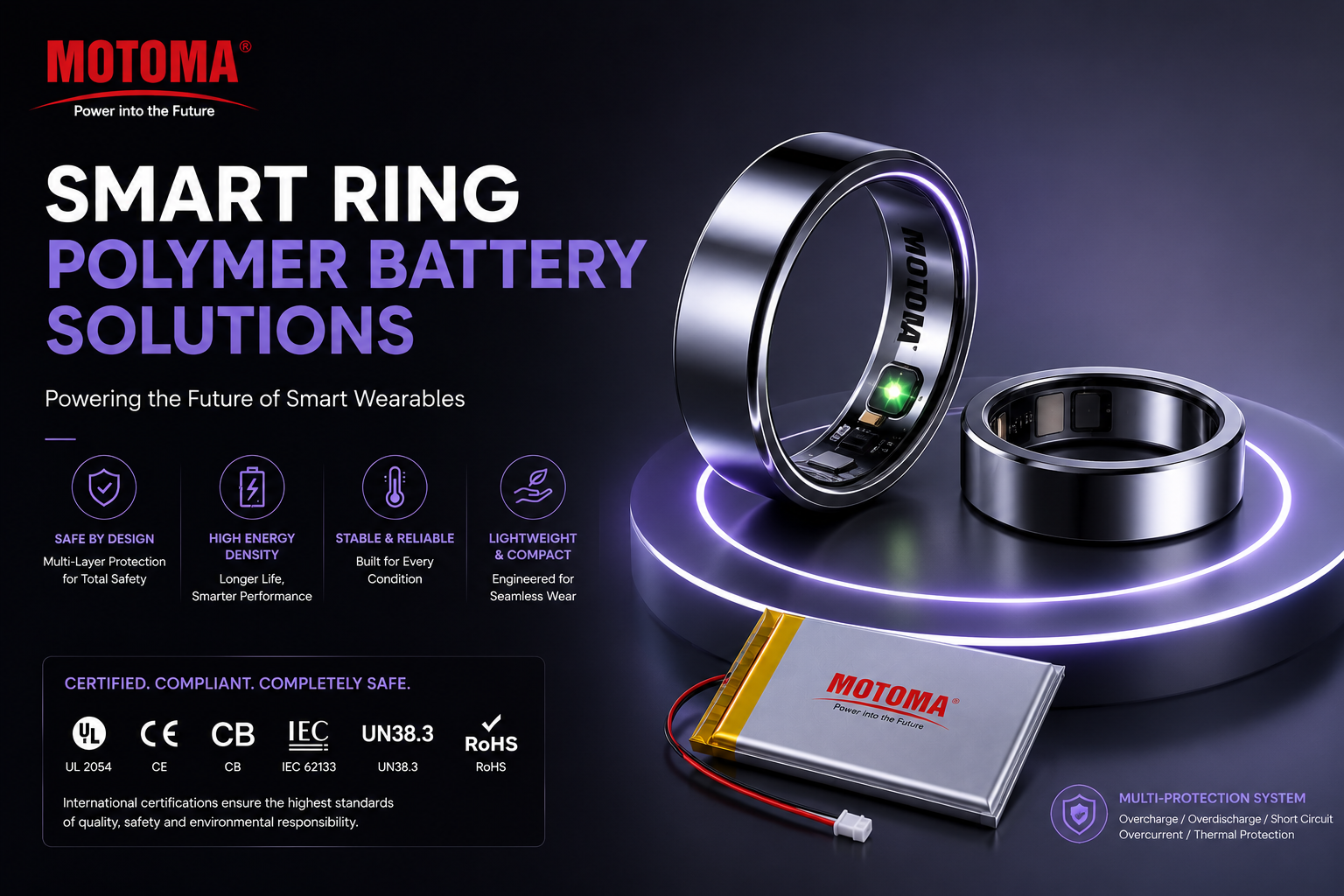
At CES 2026, smart rings moved beyond sleep tracking accessories and entered a more demanding category of wearable electronics. Today’s smart ring is expected to support continuous SpO2 monitoring, HRV analysis, body temperature sensing, NFC authentication, and AI-driven health insights — all within a ring thickness often below 2.5mm.
For product designers and electronics manufacturers, this creates a familiar challenge: how to integrate enough battery capacity without compromising comfort, thermal safety, waterproofing, or industrial design.
From an engineering standpoint, battery selection has become the key technical differentiator between short-life concept devices and commercial-grade smart rings.
Why Battery Architecture Matters More Than Sensor Innovation
| Design Constraint | Battery Impact | Engineering Solution |
|---|---|---|
| Ultra-thin ring profile | Limited internal volume | Curved polymer pouch cell |
| 24/7 biometric monitoring | Continuous discharge load | High-density 3.85V / 3.87V chemistry |
| 10ATM waterproofing | Sealed architecture required | Wireless charging compatible pouch design |
| Skin-contact safety | Strict thermal control | Ceramic-coated separator |
Core Battery Chemistry for 2026 Smart Rings
1. Curved Polymer Lithium Cells
Traditional flat lithium polymer batteries cannot efficiently utilize the annular space inside a smart ring. Custom curved pouch cells solve this by matching the internal arc geometry.
Typical specifications include:
- Voltage: 3.7V / 3.8V / 3.85V / 3.87V / 3.88V
- Capacity: 18mAh, 20mAh, 25mAh, 30mAh, 35mAh, 40mAh, 45mAh, 50mAh
- Thickness: 0.5mm – 1.2mm
- Cycle life: 500–800 cycles
For AI-enabled smart rings with continuous ECG sampling, 3.85V and 3.88V chemistries provide better runtime stability than standard 3.7V cells.
2. Silicon-Carbon High Energy Density Systems
The move from graphite-only anodes to silicon-carbon composite materials has significantly increased volumetric energy density.
For example:
- 3.7V 20mAh battery → standard wellness tracking
- 3.8V 30mAh battery → advanced health monitoring
- 3.85V 45mAh battery → ECG + AI analytics
- 3.88V 50mAh battery → medical-grade continuous sensing
Capacity Selection by Product Category
| Battery Capacity | Typical Voltage | Application |
|---|---|---|
| 20mAh – 25mAh | 3.7V / 3.8V | NFC payment rings |
| 25mAh – 30mAh | 3.8V / 3.85V | Sleep tracking rings |
| 30mAh – 40mAh | 3.85V / 3.87V | Health monitoring smart rings |
| 40mAh – 50mAh | 3.88V | Medical wearable rings |
Charging Trends: Contactless by Default
Physical charging contacts are increasingly avoided due to corrosion risks and waterproofing limitations.
CES 2026 smart ring platforms widely adopt:
- NFC wireless charging
- Magnetic charging docks
- Portable charging cases with 300mAh–1000mAh backup batteries
For B2B OEM projects, charging ecosystem integration should be considered early during battery pack development.
Safety Engineering for Skin-Contact Devices
Unlike other wearables, smart rings remain in direct skin contact for extended periods. Battery safety therefore extends beyond electrical reliability.
- Ceramic-coated separators
- Low swelling electrolyte systems
- Ultra-low thermal rise charging protocols
- Pressure-resistant curved encapsulation
How MOTOMA Supports Smart Ring OEM Development
MOTOMA works with electronics design teams to develop custom curved lithium polymer batteries for wearable devices.
Supported configurations include:
- 3.7V / 3.8V / 3.85V / 3.87V / 3.88V
- 20mAh to 100mAh
- Custom arc radius
- Flexible PCB integration
- Wireless charging optimization
Frequently Asked Questions
Q1: What battery voltage is most common for smart rings?
3.85V and 3.87V are increasingly preferred for higher energy density.
Q2: Can a 20mAh battery support 7-day operation?
Yes, if paired with aggressive power management and low-duty-cycle sensing.
Q3: Are curved polymer batteries safe for wearable use?
Yes, when designed with ceramic separators and certified protection circuits.
Q4: What is the ideal capacity for health monitoring rings?
Typically 30mAh to 45mAh depending on sensing frequency.
Q5: Does MOTOMA support custom ring battery development?
Yes, including shape customization, connector design, and charging integration support.