
Walk through the pet-tech section at CES 2026 and one thing becomes clear: the smart pet feeder is no longer a simple scheduled dispenser.
It is becoming part feeding appliance, part edge-computing device, and part health-monitoring terminal.
Today’s connected pet feeder may include:
- 1080P / 2K vision monitoring
- Edge AI pet recognition
- Multi-pet feeding algorithms
- Wet food refrigeration modules
- Wi-Fi / Matter connectivity
- Motorized portion control systems
That shift changes battery requirements completely. The old backup AA battery approach is increasingly incompatible with these power-hungry architectures. For electronics manufacturers and product development teams, custom lithium polymer battery design is now part of the feeder platform itself.
Why Battery Selection Is Becoming a Core Product Decision
| System Function | Power Demand | Battery Requirement |
|---|---|---|
| AI camera recognition | Continuous burst load | 3.8V / 3.85V high-density pouch cell |
| Motorized feeding rotor | High current pulse | 5C discharge capable polymer pack |
| Wet food refrigeration | Sustained load | 7.4V / 11.1V multi-cell system |
| Matter / Wi-Fi standby | Long standby draw | Low self-discharge chemistry |
| Emergency backup operation | Fast switching | Dual-source BMS architecture |
The Battery Architectures Emerging in 2026
1. High-Density 3.7V / 3.8V Polymer Cells
For compact wireless feeders, the most common configurations remain:
- 3.7V 2000mAh
- 3.7V 3000mAh
- 3.8V 5200mAh
- 3.85V 5000mAh
- 3.87V 6000mAh
These capacities provide enough reserve for:
- 7–30 days backup operation
- AI wake-on-motion camera activation
- Cloud sync after outage recovery
2. 7.4V High-Load Battery Packs
As automatic wet-food systems become more common, feeder mechanisms increasingly rely on higher-voltage battery platforms.
Typical packs:
- 7.4V 5000mAh
- 7.4V 8000mAh
- 7.4V 10000mAh
- 11.1V 5000mAh
These support:
- Cooling modules
- UVC sterilization
- Mechanical sealing systems
- Servo-driven portion control
Real Product Capacity Mapping
| Battery Spec | Typical Device Type | Expected Backup Runtime |
|---|---|---|
| 3.7V 2000mAh | Basic timed feeder | 5–7 days |
| 3.8V 5200mAh | AI dry food feeder | 20–30 days |
| 7.4V 7500mAh | Smart wet food system | 10–15 days |
| 7.4V 10000mAh | Premium AI feeder + refrigeration | 15–25 days |
| 11.1V 5000mAh | Commercial multi-pet station | High-load industrial use |
The Hidden Engineering Challenge: Fast Source Switching
One issue many OEM teams underestimate is transition latency.
If external USB-C PD power is interrupted, the feeder cannot reboot or pause during motor operation. A properly designed BMS must switch from wall power to internal battery in milliseconds.
This becomes critical for:
- Scheduled feeding consistency
- Wet-food door actuation
- Preventing food jams
- Maintaining cloud state synchronization
Safety Matters More in Pet Devices
Unlike consumer handheld electronics, pet feeders are floor-level appliances. That means they are exposed to:
- Pet saliva
- Water splashes
- Bite damage
- Impact from large pets
Battery protection should therefore include:
- Ceramic-coated separator
- Wide-temperature electrolyte
- Mechanical puncture resistance
- Swelling-resistant pouch structure
How MOTOMA Supports Smart Pet Device OEM Development
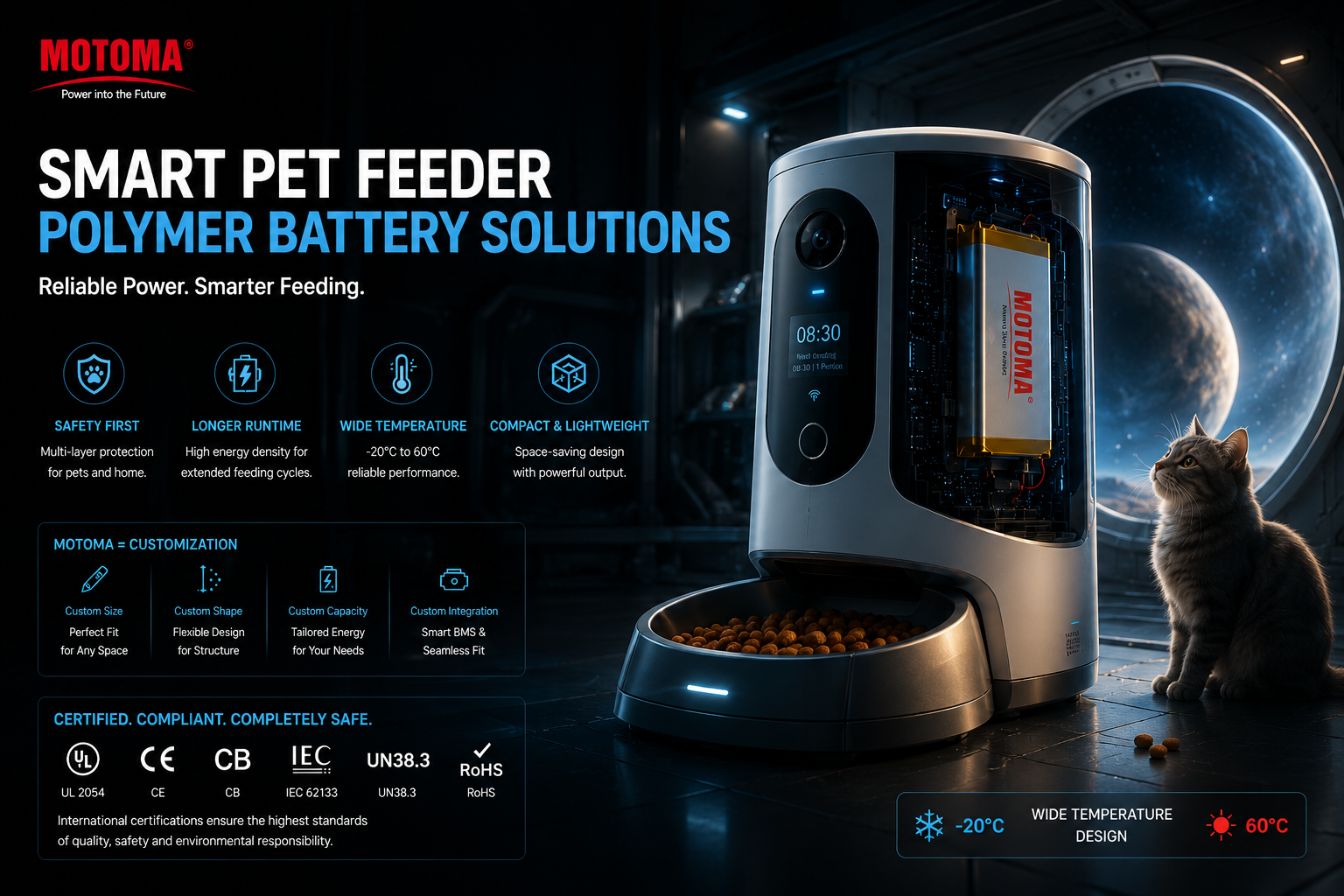
MOTOMA develops custom lithium polymer battery packs for connected pet electronics, including:
- 3.7V / 3.8V / 3.85V / 3.87V / 3.88V cells
- 7.4V / 11.1V / 14.8V battery modules
- 2000mAh to 10000mAh configurations
- Fast-switching BMS integration
- Custom shape packs for slim feeder bases
For product engineers, early battery architecture planning reduces redesign cycles later in EVT and DVT stages.
FAQ
Q1: Is 3.7V enough for an AI smart feeder?
For basic camera-equipped systems, yes. Refrigerated or motor-heavy designs usually require 7.4V or higher.
Q2: What capacity is recommended for 30-day backup?
Typically 5000mAh to 8000mAh depending on camera activity and Wi-Fi duty cycle.
Q3: Why use polymer batteries instead of cylindrical cells?
Polymer packs offer flatter geometry, better space utilization, and easier integration into modern feeder designs.
Q4: Can smart feeders use 14.8V packs?
Yes, particularly for refrigeration-assisted feeding systems and commercial-grade platforms.
Q5: Does MOTOMA support custom BMS integration?
Yes. Protection logic, charge management, and source-switching architecture can be customized per OEM project.