
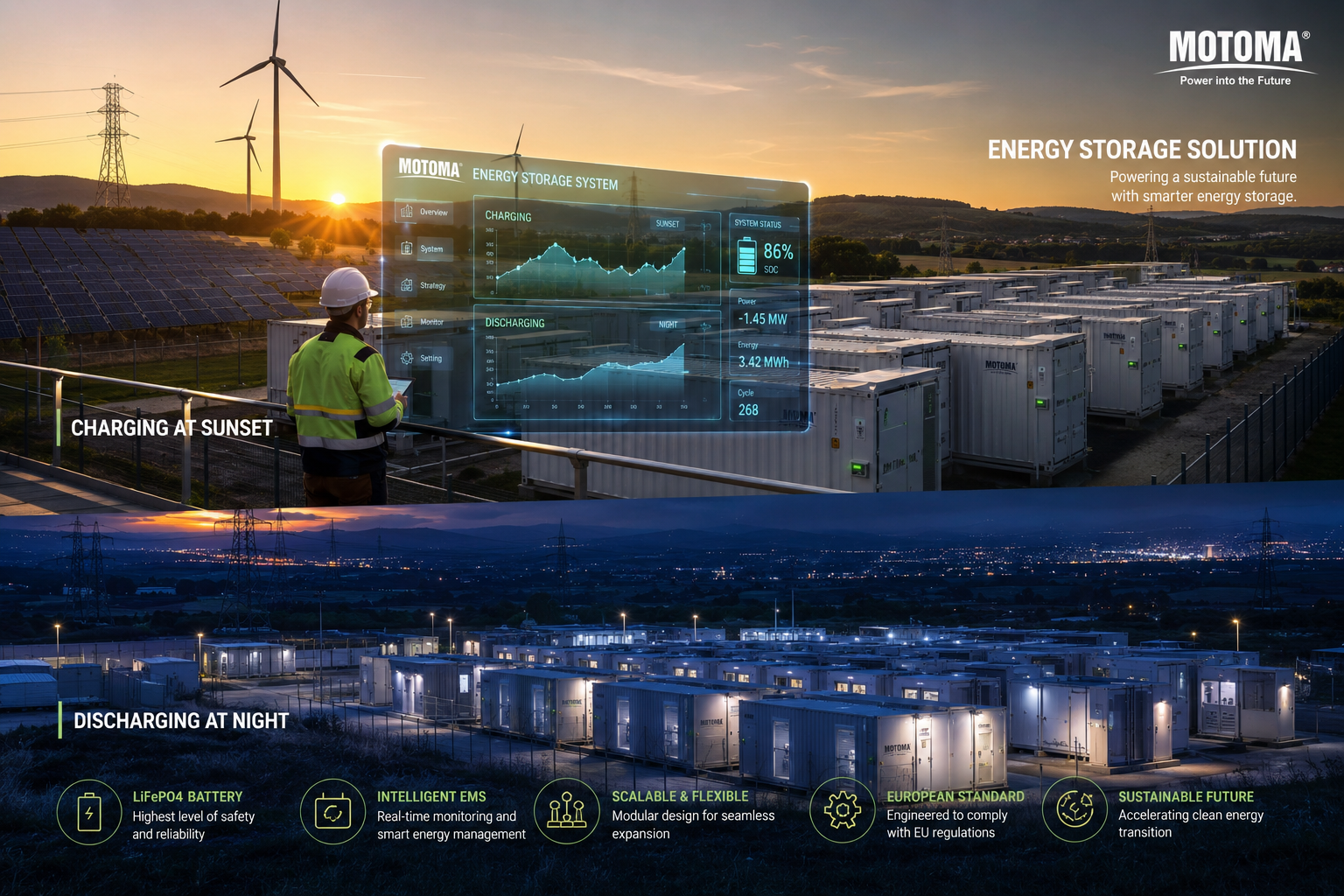
Across Europe, the conversation around renewable energy has shifted from generation capacity to energy availability. Solar farms can produce abundant electricity at noon. Wind farms can generate surplus power overnight. Yet electricity demand rarely follows the same pattern.
For project developers, EPC contractors, storage engineers, and utility operators, the challenge is no longer simply generating clean electricity. The challenge is storing it efficiently and delivering it when the grid needs it most.
This is where Long Duration Energy Storage (LDES) becomes increasingly important.
While conventional battery energy storage systems (BESS) typically provide 2-hour or 4-hour discharge durations, long-duration energy storage technologies are designed to deliver power for 6 hours, 8 hours, 10 hours, 12 hours, and even beyond 24 hours. Their role becomes increasingly valuable as renewable penetration rises and Europe moves toward net-zero electricity systems.
Why Traditional Grid Infrastructure Faces New Challenges
Historically, European grids relied on predictable generation sources such as coal, gas, hydro, and nuclear power. Operators could increase or reduce output based on demand.
Renewable energy sources behave differently:
- Solar generation peaks during daylight hours.
- Wind production depends on weather conditions.
- Demand peaks often occur after sunset.
- Seasonal generation patterns vary significantly.
- Grid congestion causes renewable curtailment.
As renewable energy integration exceeds 40%, 50%, or even 70% in some regions, maintaining frequency stability, voltage control, and dispatchable power becomes increasingly complex.
This creates a growing need for flexible electricity storage solutions capable of bridging long periods between generation and consumption.
Understanding Long Duration Energy Storage
Long Duration Energy Storage refers to systems capable of continuously discharging electricity for extended periods, typically exceeding 6 hours.
| Storage Category | Typical Duration | Main Application |
|---|---|---|
| Short Duration Storage | 1-2 Hours | Frequency regulation |
| Medium Duration Storage | 2-4 Hours | Peak shaving, self-consumption |
| Long Duration Storage | 6-12 Hours | Renewable shifting, backup power |
| Ultra Long Duration Storage | 12-100+ Hours | Seasonal balancing, grid resilience |
Technologies supporting LDES include:
- Large-scale LiFePO4 battery systems
- Flow batteries
- Compressed air energy storage
- Pumped hydro storage
- Thermal energy storage
- Hydrogen-based storage systems
For most commercial and utility-scale projects currently deployed across Europe, lithium battery energy storage systems remain the most mature and commercially available option.
The Value of LDES Under Different Grid Conditions
Scenario 1: High Renewable Penetration Grids
Countries such as Germany, Spain, Denmark, and the Netherlands are rapidly increasing solar and wind deployment.
During periods of strong sunlight or high wind speeds, electricity production often exceeds immediate demand. Without storage, valuable renewable energy must be curtailed.
| Challenge | Impact | LDES Benefit |
|---|---|---|
| Solar overproduction | Negative electricity pricing | Store excess generation |
| Wind curtailment | Lost renewable output | Shift energy to peak periods |
| Evening demand peaks | Grid stress | Provide dispatchable power |
An 8MW/32MWh or 10MW/40MWh battery energy storage system can absorb midday solar surplus and discharge electricity during evening peak demand, reducing dependence on fossil-fuel peaker plants.
Scenario 2: Weak Grid Regions and Remote Communities
Many industrial facilities, islands, mining operations, and remote communities operate in areas with limited grid infrastructure.
These locations frequently experience:
- Voltage instability
- Power interruptions
- Limited transmission capacity
- High diesel fuel costs
Long-duration storage combined with solar PV systems and hybrid inverters enables stable microgrid operation while reducing fuel consumption.
Typical configurations may include:
- 500kW solar array + 1MWh battery
- 1MW solar system + 4MWh storage
- 5MW renewable microgrid + 20MWh storage
This improves energy security while lowering operating costs and carbon emissions.
Scenario 3: Industrial and Commercial Facilities
Manufacturing plants increasingly face volatile electricity prices across Europe.
Industrial users operating:
- CNC machinery
- Cold storage facilities
- Data centers
- Automated production lines
- Electric vehicle charging hubs
often require stable electricity around the clock.
Long-duration storage enables:
- Peak demand reduction
- Time-of-use energy arbitrage
- Backup power support
- Higher solar self-consumption rates
- Reduced grid dependency
For example, a facility equipped with a 500kW hybrid inverter system and a 1MWh, 2MWh, or 5MWh storage bank can significantly improve operational flexibility during electricity price fluctuations.
The Economics of Long Duration Storage
A common misconception is that longer duration storage is simply more expensive.
In practice, economics depend on the application.
| Project Objective | Preferred Duration |
|---|---|
| Frequency regulation | 1-2 hours |
| Peak shaving | 2-4 hours |
| Solar energy shifting | 4-8 hours |
| Grid resilience | 8-12 hours |
| Emergency backup | 12+ hours |
As battery cell costs continue to decline and energy management systems become more intelligent, the cost per delivered kilowatt-hour over a project‘s lifetime is steadily improving.
For many commercial and utility-scale projects, the economic benefits now extend beyond simple electricity savings to include:
- Capacity market participation
- Grid ancillary services
- Demand charge reduction
- Carbon reduction incentives
- Energy independence
How Hybrid Energy Storage Improves Performance
Many modern projects combine multiple technologies within a hybrid energy storage architecture.
A typical hybrid energy storage system may integrate:
- Solar PV modules (430W, 550W, 600W, 700W)
- Hybrid inverters (5kW, 8kW, 10kW, 15kW, 50kW, 100kW)
- LiFePO4 battery banks (51.2V, 102.4V, 512V, 768V)
- Energy Management Systems (EMS)
- Backup generators
This layered architecture enables energy system optimization by balancing efficiency, response speed, reliability, and operational cost.
The Future of Grid Decarbonization Depends on Storage
Achieving a zero-emission electricity system requires more than installing additional solar panels and wind turbines.
Renewable generation must be supported by storage infrastructure capable of shifting electricity across hours, days, and potentially seasons.
Long duration energy storage provides the flexibility necessary to maintain grid reliability while maximizing renewable energy utilization. For utilities, industrial operators, EPC contractors, and storage integrators, it is increasingly becoming a critical component of future energy system design.
Frequently Asked Questions
1. What is considered long duration energy storage?
Most industry definitions classify storage systems with discharge durations exceeding 6 hours as long duration energy storage.
2. Is LiFePO4 suitable for long-duration storage projects?
Yes. LiFePO4 battery systems offer high cycle life, strong safety performance, and are widely used in commercial and utility-scale energy storage projects.
3. What storage duration is recommended for solar energy shifting?
Typically 4 to 8 hours of storage provides effective shifting of midday solar generation to evening demand periods.
4. Can long duration storage replace diesel generators?
In many applications, long-duration battery storage combined with solar generation can significantly reduce or even eliminate diesel generator runtime.
5. Why is long duration storage important for renewable energy integration?
It helps absorb surplus renewable generation and deliver electricity when renewable production decreases, improving grid stability and renewable utilization.
6. What role does EMS play in long-duration storage projects?
An Energy Management System optimizes charging, discharging, demand response, and energy trading strategies to maximize system value.
7. What battery voltage platforms are commonly used in large storage systems?
Common battery architectures include 51.2V, 102.4V, 512V, 614V, 768V, and 1500V DC systems depending on project scale.