
Across Europe, increasing grid instability, rising electricity costs, and the rapid growth of distributed renewable energy systems are driving greater interest in microgrids and backup power systems. For industrial facilities, commercial buildings, logistics centers, hospitals, data centers, and remote sites, maintaining a stable power supply during grid outages is no longer optional—it is becoming an operational necessity.
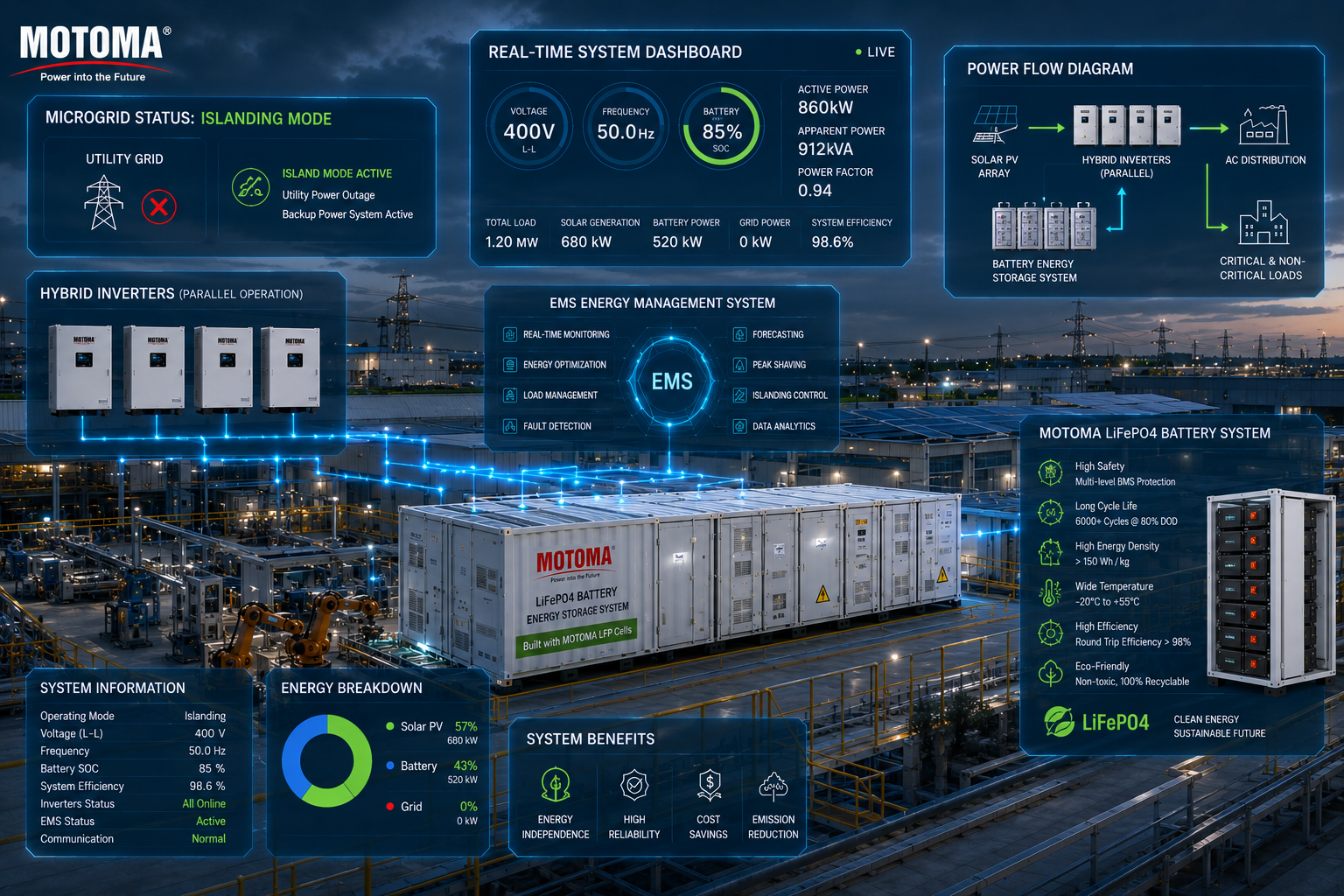
When a utility outage occurs, a microgrid transitions into islanding mode, disconnecting from the public grid and operating independently. During this period, multiple parallel inverters often work together with battery energy storage systems (BESS), solar PV generation, and backup generators to maintain voltage, frequency, and power quality.
However, simply connecting several inverters in parallel does not automatically guarantee high performance. Without proper coordination, systems can experience unequal load sharing, frequency deviations, excessive circulating currents, reduced battery efficiency, and unstable operation.
This article explores practical strategies for improving parallel inverter control in islanded microgrids and explains how optimized control architectures can increase reliability, efficiency, and backup power performance.
Why Parallel Inverters Are Important in Modern Microgrids
Most commercial and industrial energy storage projects today require scalable power architectures. Instead of installing a single large inverter, system designers often deploy multiple inverter modules operating in parallel.
Typical examples include:
- Two parallel 50kW hybrid inverters creating a 100kW system
- Four 125kW PCS units operating as a 500kW microgrid
- Ten 100kW battery inverters supporting a 1MW industrial energy storage system
- Residential backup systems combining multiple 8kW, 10kW, 12kW, 15kW, or 20kW hybrid inverters
Parallel architecture offers several advantages:
- Higher system redundancy
- Improved scalability
- Simplified maintenance
- Better load distribution
- Flexible future expansion
- Enhanced reliability during islanded operation
Challenges During Microgrid Islanding Operation
When the utility grid disappears, the inverter network becomes responsible for establishing and maintaining system frequency and voltage.
Several technical challenges immediately emerge:
| Challenge | Potential Impact |
|---|---|
| Uneven Load Sharing | Overloading of specific inverter units |
| Frequency Drift | Reduced power quality and instability |
| Voltage Fluctuation | Equipment malfunction and sensitive load interruptions |
| Circulating Current | Additional losses and overheating |
| Battery Utilization Imbalance | Reduced battery lifespan |
| Communication Delays | Slower system response during disturbances |
For industrial facilities operating CNC equipment, automated production lines, data processing equipment, refrigeration systems, or medical devices, even small power quality disturbances can create significant operational risks.
Core Control Strategies for Parallel Inverter Systems
1. Droop Control Technology
Droop control remains one of the most widely adopted methods for inverter parallel operation.
The principle is similar to traditional synchronous generators. As load demand increases, each inverter adjusts its output frequency and voltage according to predefined droop characteristics.
Benefits include:
- No centralized controller required
- Excellent scalability
- Fast response to load changes
- Suitable for distributed generation environments
Typical industrial applications include:
- 50kW microgrids
- 100kW commercial storage systems
- 250kW manufacturing facilities
- 500kW to 1MW industrial parks
2. Master-Slave Control Architecture
In this configuration, one inverter acts as the master controller while remaining units operate as followers.
The master establishes system voltage and frequency references while slave inverters synchronize their outputs accordingly.
Advantages:
- High control precision
- Stable voltage regulation
- Simplified commissioning process
- Suitable for backup power systems
This approach is commonly used in hospitals, commercial buildings, and critical infrastructure projects where stable power delivery is essential.
3. Distributed Consensus Control
Modern energy management systems increasingly utilize distributed communication networks to coordinate inverter operation.
Each inverter exchanges information with neighboring units, enabling dynamic optimization without relying on a single control point.
This approach offers:
- Improved fault tolerance
- Enhanced redundancy
- Better power sharing accuracy
- Higher operational efficiency
Optimizing Battery Storage Performance During Islanding
In most islanded microgrids, battery storage systems provide the primary balancing resource.
Modern LiFePO4 battery systems operating at 51.2V, 96V, 204.8V, 512V, 768V, or 1000V platforms can respond within milliseconds to sudden load changes.
Proper inverter coordination allows batteries to:
- Reduce peak demand stress
- Maintain stable voltage
- Improve solar utilization
- Support black start functionality
- Reduce generator runtime
- Increase system efficiency
| Battery Capacity | Typical Application |
|---|---|
| 10kWh-30kWh | Residential Backup Systems |
| 50kWh-200kWh | Commercial Buildings |
| 250kWh-500kWh | Industrial Facilities |
| 1MWh-5MWh+ | Microgrids and Industrial Parks |
The Role of Energy Management Systems (EMS)
An advanced EMS serves as the intelligence layer of the microgrid.
Rather than allowing each inverter to operate independently, the EMS coordinates:
- Battery charging and discharging schedules
- PV generation forecasting
- Load prioritization
- Frequency regulation
- State of Charge (SOC) balancing
- Generator dispatch optimization
- Demand response participation
For European projects operating under dynamic electricity tariffs, EMS integration can significantly improve system economics while maintaining reliable backup power capability.
Typical Microgrid Configuration Example
| Component | Specification |
|---|---|
| Solar PV Array | 500kW |
| Battery Storage | 1MWh LiFePO4 |
| Hybrid Inverters | 4 × 125kW Parallel Units |
| Battery Voltage | 768V DC |
| PCS Efficiency | 98.5% |
| Communication | CAN, Modbus TCP, RS485 |
| Operating Mode | Grid-Tied + Islanding |
| Backup Transition Time | 0ms – 10ms Depending on Configuration |
Benefits for European Commercial and Industrial Projects
For EPC companies, solar installers, distributors, and project developers, optimized parallel inverter control provides tangible benefits:
- Higher backup power reliability
- Improved renewable energy utilization
- Reduced battery cycling losses
- Enhanced system lifespan
- Lower maintenance requirements
- Greater project scalability
- Improved compliance with European grid standards
As distributed generation continues to expand across Europe, microgrid islanding capability is becoming an important consideration for energy resilience strategies.
MOTOMA Microgrid and Energy Storage Solutions
MOTOMA provides scalable energy storage systems, hybrid inverter solutions, and intelligent EMS platforms designed for commercial and industrial microgrid applications. Through advanced parallel inverter architectures, LiFePO4 battery technology, and localized technical support, system operators can improve backup power performance while maximizing renewable energy utilization.
Whether deploying a 10kW residential backup system, a 100kW commercial energy storage installation, or a multi-megawatt industrial microgrid, efficient inverter coordination remains one of the key factors influencing long-term system reliability and operational performance.
Frequently Asked Questions (FAQ)
1. What is microgrid islanding?
Microgrid islanding occurs when a local power system disconnects from the utility grid and continues operating independently using local generation and energy storage resources.
2. Why are multiple inverters connected in parallel?
Parallel operation increases system capacity, redundancy, flexibility, and reliability while simplifying future expansion.
3. Which control strategy is most common for parallel inverters?
Droop control remains one of the most widely used methods because of its simplicity, scalability, and ability to support decentralized operation.
4. How quickly can battery systems respond during islanding?
Modern LiFePO4 battery storage systems can respond within milliseconds, helping stabilize voltage and frequency during sudden load changes.
5. Can parallel inverter systems support 0ms backup switching?
Certain hybrid inverter and UPS-class energy storage configurations can provide near-zero transfer time, ensuring continuous power for critical loads.
6. How does EMS improve microgrid performance?
EMS coordinates batteries, solar generation, loads, and inverters to improve efficiency, reduce costs, and maintain system stability.
7. Are parallel inverter microgrids suitable for Europe?
Yes. They are increasingly deployed in industrial parks, commercial facilities, agricultural operations, EV charging infrastructure, and renewable energy projects across Europe.