
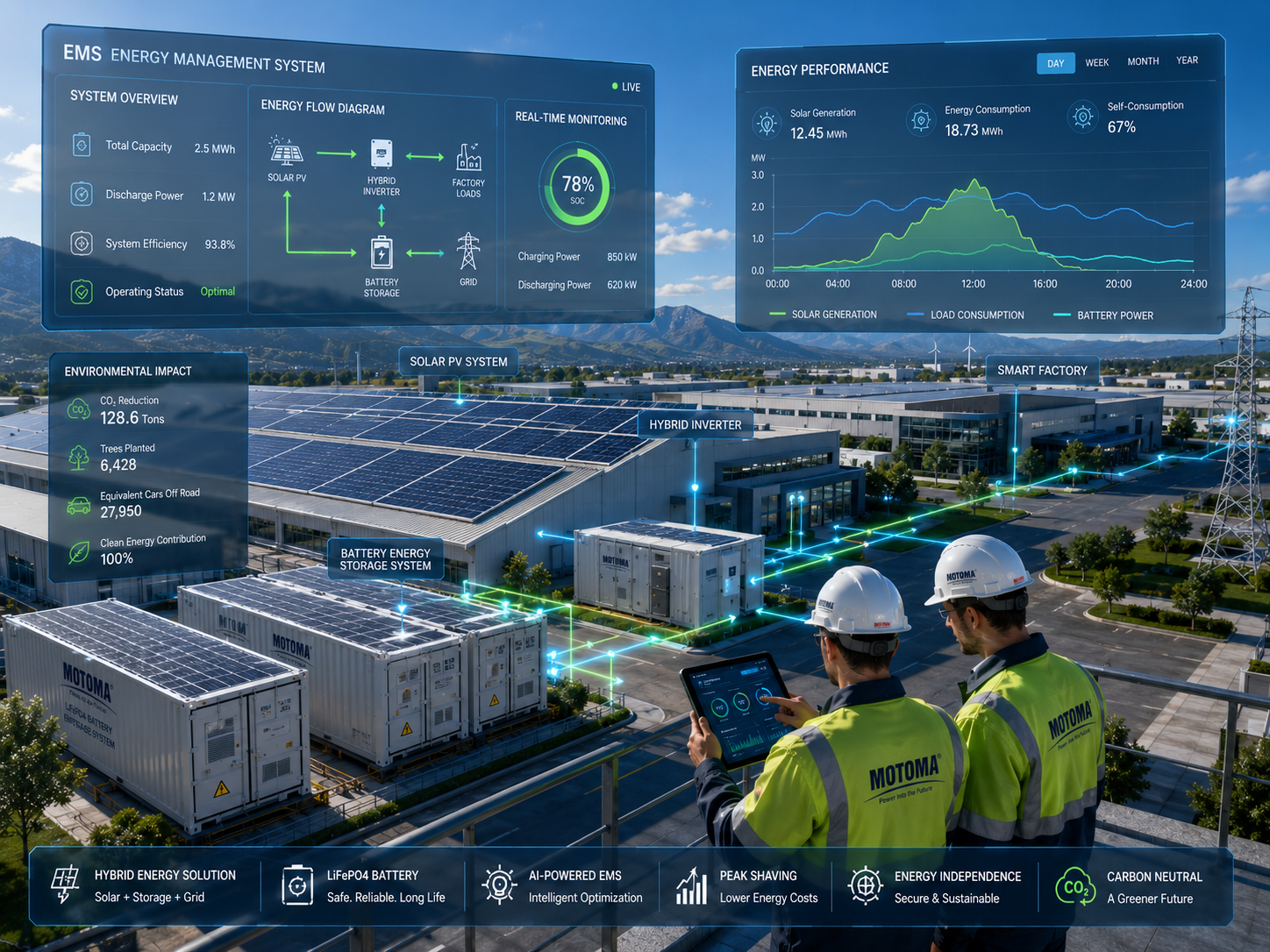
As electricity prices become increasingly volatile across Europe, industrial facilities face growing pressure to reduce operating costs while meeting sustainability targets. Many factories, logistics centers, manufacturing plants, and commercial parks have already installed photovoltaic (PV) systems, yet solar generation alone cannot solve issues such as peak demand charges, intermittent renewable production, and grid instability.
This is where a hybrid energy storage system (HESS) becomes valuable. By combining multiple energy storage technologies with intelligent control strategies, a hybrid energy storage system can improve renewable energy integration, optimize power consumption, reduce carbon emissions, and enhance energy reliability.
From an engineering perspective, successful hybrid energy storage systems design is not only about selecting batteries. The real challenge is finding the right balance between equipment sizing, power conversion architecture, and operational scheduling throughout the project lifecycle.
What Is a Hybrid Energy Storage System?
A hybrid energy storage system combines two or more energy storage technologies working together under a unified Energy Management System (EMS). The most common configuration in industrial energy systems combines:
- Lithium-ion battery storage (LiFePO4 battery systems)
- Supercapacitors for high-power transient response
- Diesel generators or backup power sources
- Solar PV generation systems
- Grid-connected and off-grid operating modes
The objective is simple: allow each technology to perform the task it handles most efficiently.
| Technology | Main Function | Response Speed | Typical Duration |
|---|---|---|---|
| LiFePO4 Battery Storage | Peak shaving & energy shifting | Milliseconds | 1-8 Hours |
| Supercapacitor | Instant power support | Microseconds | Seconds-Minutes |
| PV Solar System | Renewable generation | Real-time | Daylight Hours |
| Backup Generator | Emergency supply | Seconds | Extended Runtime |
Why Industrial Parks Need Hybrid Storage Solutions
Industrial energy consumption rarely follows a stable pattern. Production equipment, HVAC systems, electric vehicle charging stations, compressors, and process machinery often create sudden power peaks.
For example, a factory with a 500kW average load may experience short-duration peaks exceeding 800kW or even 1MW. Utilities frequently calculate demand charges based on these peak values rather than average consumption.
Without storage, companies pay for electricity capacity they only use briefly. A properly designed hybrid battery energy storage system can absorb excess solar energy and discharge during expensive tariff periods.
Typical Industrial Energy Challenges
- Rising electricity tariffs
- Demand charge penalties
- Intermittent solar generation
- Power quality fluctuations
- Carbon reduction requirements
- Grid congestion limitations
- Expansion of EV charging infrastructure
Layered Optimization Framework for Hybrid Energy Storage Systems Design
Modern industrial projects increasingly adopt a layered optimization framework that combines equipment configuration optimization with operational scheduling optimization.
Layer 1: Equipment Configuration Optimization
The first layer determines system hardware sizing:
- Solar PV capacity: 100kW, 500kW, 1MW, 5MW+
- Battery capacity: 50kWh, 200kWh, 500kWh, 1MWh, 5MWh+
- PCS power rating: 50kW, 100kW, 250kW, 500kW, 1MW
- DC voltage platforms: 48V, 51.2V, 96V, 512V, 768V, 1000V
- Battery rack configuration and scalability
Layer 2: Operational Scheduling Optimization
After hardware selection, intelligent EMS software continuously optimizes system operation according to:
- Real-time electricity pricing
- Weather forecasts
- PV production predictions
- Factory load forecasting
- Battery State of Charge (SOC)
- Grid export limitations
The result is a coordinated charging and discharging strategy that maximizes economic returns while protecting battery life.
Typical Technical Parameters for Industrial Hybrid Storage Systems
| Parameter | Typical Value |
|---|---|
| Battery Chemistry | LiFePO4 (LFP) |
| Nominal Voltage | 51.2V / 102.4V / 512V / 768V |
| System Capacity | 100kWh - 5MWh+ |
| PCS Efficiency | 97%-99% |
| Battery Round-trip Efficiency | 92%-96% |
| Cycle Life | 6000-10000 Cycles |
| Communication Protocol | CAN / RS485 / Modbus TCP |
| Grid Standards | EN50549, CEI 0-21, VDE4105 |
| Protection Rating | IP54-IP65 |
| Operating Temperature | -20°C to 60°C |
Renewable Energy Integration Benefits
One of the primary goals of hybrid energy storage system design is increasing renewable energy utilization.
Without storage, excess solar production during midday may be curtailed or exported to the grid at relatively low compensation rates. With battery storage, surplus energy can be stored and later used during evening production shifts or periods of higher electricity pricing.
Many industrial customers achieve:
- Higher solar self-consumption rates
- Reduced grid dependency
- Improved power quality
- Lower carbon emissions
- Enhanced energy resilience
- Faster renewable energy ROI
Key Considerations When Selecting a Hybrid Energy Storage Supplier
For EPC contractors, distributors, and project developers, supplier selection should extend beyond battery specifications.
| Evaluation Item | Why It Matters |
|---|---|
| System Integration Capability | Ensures seamless operation between PV, battery and EMS |
| Local Technical Support | Faster commissioning and troubleshooting |
| European Certifications | Compliance with local regulations |
| Scalability | Supports future expansion |
| Remote Monitoring Platform | Improves operational visibility |
| Warranty & Service | Reduces long-term project risk |
MOTOMA Industrial Hybrid Energy Storage Solutions
MOTOMA provides integrated industrial and commercial energy storage solutions designed for renewable energy integration and energy system optimization. Through intelligent EMS management, LiFePO4 battery technology, high-efficiency PCS architecture, and local support capabilities, industrial customers can improve energy utilization while reducing operational costs.
Whether the application involves a 100kWh commercial battery system, a 500kWh factory energy storage installation, or a multi-megawatt industrial energy system, the design objective remains consistent: maximize renewable energy utilization, reduce peak demand costs, and maintain stable power supply.
Frequently Asked Questions (FAQ)
1. What is the main advantage of a hybrid energy storage system?
A hybrid system combines different technologies to improve efficiency, reduce electricity costs, and enhance renewable energy utilization compared with a single storage technology.
2. How much battery capacity does an industrial facility need?
Capacity depends on load profile, solar generation, tariff structure, and backup requirements. Typical projects range from 100kWh to several MWh.
3. Can hybrid storage systems work with existing solar installations?
Yes. Most modern battery systems can be integrated with existing photovoltaic systems through AC-coupled or DC-coupled configurations.
4. What battery chemistry is commonly used for industrial storage?
LiFePO4 batteries are widely adopted because of their thermal stability, long cycle life, and safety characteristics.
5. How does EMS improve system performance?
EMS software continuously analyzes energy production, consumption, battery status, and electricity pricing to optimize charging and discharging decisions automatically.
6. Can a hybrid energy storage system reduce carbon emissions?
Yes. By increasing renewable energy consumption and reducing dependence on fossil-fuel-generated grid electricity, carbon emissions can be significantly reduced.
7. Is hybrid energy storage suitable for Europe?
Yes. Dynamic electricity tariffs, renewable energy incentives, and increasing energy prices make hybrid storage systems particularly relevant for European industrial and commercial applications.