
In recent years, many battery engineers working on large-scale energy storage systems have started asking the same question:
“How far can current lithium-ion technology still go?”
For residential ESS, commercial battery storage, microgrid backup systems, and utility-scale renewable integration, traditional graphite-based lithium-ion batteries are already approaching practical limits in energy density. Fast charging performance also remains a challenge, especially under high current charging conditions such as 1C, 2C, or even 4C operation.
This is why lithium metal battery research has once again become a major discussion point in both academic laboratories and industrial battery development programs.
Why Lithium Metal Batteries Are Becoming Important
Most current energy storage systems still rely on conventional lithium-ion chemistry using graphite anodes. These systems are already widely deployed in:
- 48V residential energy storage systems
- 51.2V LiFePO4 battery packs
- 5kWh, 10kWh, 15kWh and 20kWh ESS cabinets
- Hybrid inverter backup systems
- Commercial peak shaving projects
- Industrial microgrid applications
However, engineers are increasingly facing physical limitations related to energy density, charging speed, and installation footprint.
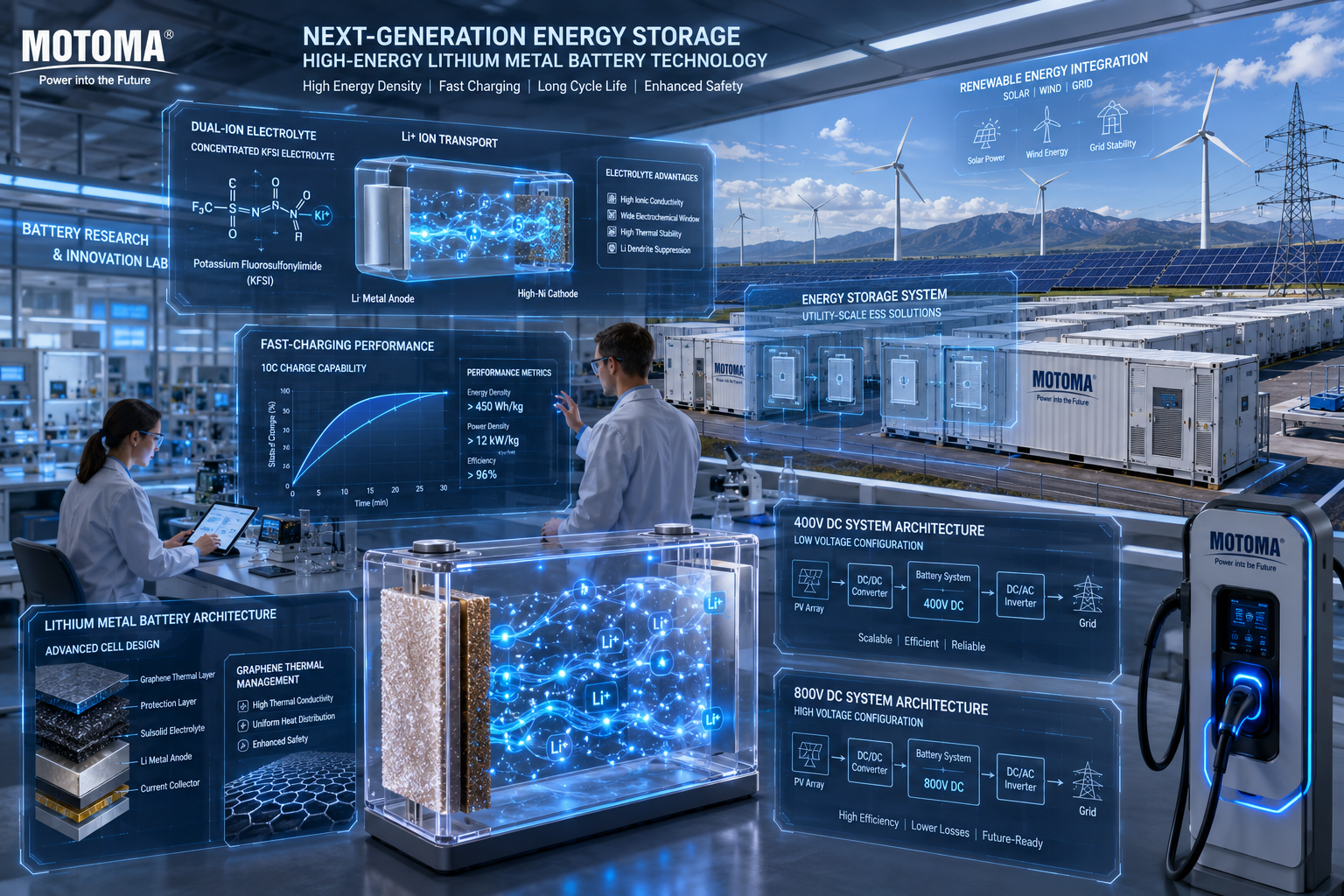
Lithium metal batteries offer a possible pathway forward because lithium metal itself has an extremely high theoretical capacity of approximately 3860mAh/g, significantly higher than graphite.
| Battery Type | Theoretical Capacity | Typical Application |
|---|---|---|
| Graphite Lithium-Ion | 372mAh/g | Current ESS and EV systems |
| Lithium Metal Battery | 3860mAh/g | Next-generation high-energy systems |
For energy storage integrators, this means future battery systems may achieve higher kWh capacity without continuously increasing cabinet size or weight.
The Real Engineering Challenge: Fast Charging Stability
Many people assume fast charging is mainly a thermal issue. In practice, the bigger challenge is often lithium deposition stability.
Under aggressive charging conditions, Li⁺ ions can deposit unevenly on the lithium metal surface, creating dendrites and unstable interface layers.
This can lead to:
- Capacity degradation
- Internal short circuits
- Poor cycle life
- Thermal instability
- Reduced charging efficiency
This becomes especially important in high-power applications such as:
- Industrial ESS systems
- Fast EV charging stations
- Microgrid backup systems
- AI data center energy storage
- High-power PCS applications
How Li⁺ Solvation Engineering Improves Performance
Recent research focuses on tuning Li⁺ solvation structures using electron-withdrawing and lithiophobic functional groups.
In simpler engineering language, the objective is to improve how lithium ions move and deposit during charging and discharging.
A more stable Li⁺ transport environment can help:
- Reduce dendrite formation
- Improve charging uniformity
- Increase fast charging capability
- Improve interface stability
- Extend battery cycle life
This approach is attracting attention because it addresses problems at the electrolyte and interface level instead of relying only on external thermal management.
Voltage Platforms and System Compatibility
Future lithium metal battery systems may support multiple voltage platforms depending on application requirements:
- 3.7V lithium cells
- 3.8V high-voltage lithium batteries
- 3.85V and 3.87V polymer lithium cells
- 3.88V high-density pouch batteries
- 7.4V battery modules
- 11.1V industrial battery packs
- 48V and 51.2V ESS systems
- 400V and 800V DC architectures
For battery pack designers, compatibility with:
- CAN communication
- RS485 protocols
- Hybrid inverter systems
- Parallel battery configurations
- BMS protection logic
will remain critical regardless of future chemistry changes.
Potential Benefits for Energy Storage Systems
| ESS Requirement | Potential Benefit from Lithium Metal Batteries |
|---|---|
| Higher energy density | More kWh in smaller cabinets |
| Fast charging capability | Improved charging efficiency during low electricity pricing periods |
| Reduced installation footprint | Better for urban and indoor ESS deployment |
| Dynamic renewable integration | Faster response to solar and wind fluctuations |
| Backup power performance | Higher discharge capability during peak loads |
Why Europe Is Paying Attention to This Technology
In many European markets, electricity prices fluctuate significantly throughout the day.
As a result, energy storage systems increasingly need:
- Fast charging during low-tariff periods
- High-efficiency discharge during peak pricing
- Long cycle stability above 6000 cycles or 8000 cycles
- High inverter efficiency above 98%
- Battery system efficiency above 95%
This is one reason why research into advanced battery chemistry continues to accelerate across Europe.
Commercialization Challenges Still Remain
Although laboratory results are promising, several practical issues still need to be solved before lithium metal batteries can be widely deployed in grid-scale storage:
- Electrolyte cost control
- Large-scale manufacturing stability
- Long-term cycle verification
- Safety certification
- Thermal management integration
- Mass production consistency
For many current applications, LiFePO4 battery systems remain the more commercially mature option.
Conclusion
Lithium metal batteries enabled by Li⁺ solvation engineering represent an important research direction for future high-energy and fast-charging energy storage systems.
While commercialization still requires further validation, the technology demonstrates strong potential for:
- High-density ESS systems
- Fast-response industrial storage
- Renewable energy integration
- High-power charging infrastructure
- Future decentralized energy systems
For energy storage engineers and system integrators, electrolyte engineering may soon become just as important as inverter efficiency, BMS communication protocols, and thermal management design.
FAQ
1. What is a lithium metal battery?
A lithium metal battery uses lithium metal as the anode instead of graphite, allowing significantly higher theoretical energy density.
2. Why are lithium metal batteries considered suitable for future ESS applications?
Because they may provide higher energy density, faster charging capability, and smaller installation footprints for stationary storage systems.
3. What is Li⁺ solvation engineering?
It is the process of modifying electrolyte chemistry to improve lithium ion transport and stabilize battery interface behavior.
4. What are the challenges of fast charging lithium metal batteries?
The biggest challenges include dendrite formation, interface instability, heat generation, and long-term cycle degradation.
5. Can lithium metal batteries replace LiFePO4 immediately?
Not yet. LiFePO4 remains more mature and commercially stable for most current energy storage applications.
6. Which future applications may benefit most from lithium metal batteries?
AI data centers, industrial ESS, fast EV charging infrastructure, and high-density renewable storage systems may benefit significantly.