
One of the most common complaints from wearable device users is surprisingly simple: battery life rarely matches the promise of all-day intelligence.
Whether it is a smart health patch, AI-powered hearing aid, fitness tracker, smart ring, medical monitoring device, AR glasses, electronic skin, or industrial wearable sensor, engineers are constantly balancing three competing requirements:
- Smaller and lighter products
- Longer operating time
- More sensors, wireless connectivity, and AI processing
For product designers and electronic manufacturers, traditional power architectures are becoming increasingly difficult to adapt to ultra-thin, flexible, and body-conforming devices. This challenge has accelerated interest in flexible energy storage systems that combine energy harvesting and energy storage into a single integrated platform.
At MOTOMA, we regularly see development teams looking for battery solutions that not only fit inside compact wearable products but also support future concepts such as self-powered electronics, flexible displays, biometric sensing, and continuous health monitoring.
Why Traditional Power Solutions Are Reaching Their Limits
Most wearable products today rely on rechargeable lithium batteries ranging from 50mAh to 1000mAh. Common voltage platforms include 3.7V, 3.8V, 3.85V, 3.87V, and 3.88V lithium polymer cells.
While these batteries provide excellent energy density, device manufacturers face several challenges:
| Design Challenge | Impact on Product Development |
|---|---|
| Limited internal space | Reduces battery capacity options |
| Complex product shapes | Requires customized battery geometry |
| Increasing sensor count | Higher power consumption |
| Continuous wireless communication | Shorter operating time |
| User comfort requirements | Demands thinner and lighter batteries |
A smartwatch may use a 150mAh or 300mAh battery, while smart glasses often require 500mAh to 1000mAh battery packs. Medical wearable devices can range from 100mAh micro batteries to 5000mAh external wearable battery modules depending on operating duration.
The Concept Behind Flexible Energy Harvesting and Storage
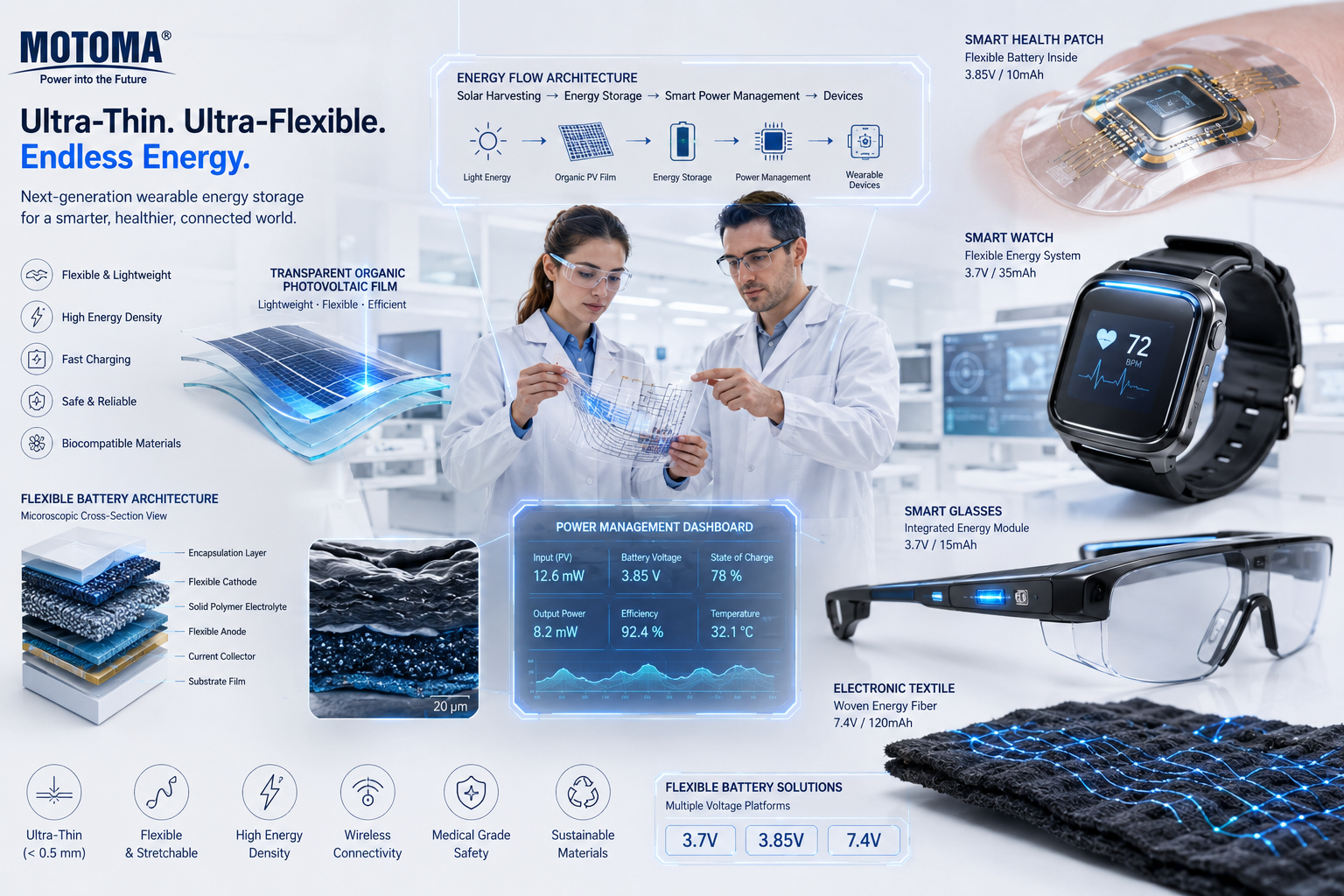
A new approach emerging across research laboratories and advanced consumer electronics programs is the integration of organic photovoltaic (OPV) technology with flexible rechargeable batteries.
Instead of relying exclusively on charging cables or charging docks, wearable devices can continuously collect ambient energy while storing excess power for later use.
The architecture generally consists of:
- Flexible organic photovoltaic modules
- Ultra-thin energy management circuits
- Flexible rechargeable battery systems
- Low-power wireless communication modules
- Intelligent battery management systems
The result is an energy harvesting-storage platform capable of extending runtime while reducing charging frequency.
Organic Photovoltaic Technology in Wearable Devices
Unlike traditional rigid silicon solar panels, organic photovoltaic modules are lightweight, bendable, and suitable for integration into wearable products.
Engineers can incorporate OPV materials into:
- Smart clothing
- Fitness bands
- Medical patches
- AR and VR headsets
- Industrial safety wearables
- Electronic skin devices
- Smart backpacks and outdoor equipment
Under indoor lighting conditions, OPV modules can generate supplemental power that helps maintain low-power sensors, Bluetooth communication modules, and environmental monitoring systems.
Flexible Battery Technologies for Wearable Electronics
Energy harvesting alone cannot provide stable power output. A storage component remains essential.
Several battery technologies are currently being evaluated for flexible energy storage systems.
| Battery Type | Advantages | Typical Applications |
|---|---|---|
| Flexible Lithium Polymer Battery | High energy density, mature supply chain | Smartwatches, smart glasses, health monitors |
| Zinc-Ion Battery | Enhanced safety and flexibility | Medical wearables, skin electronics |
| Thin Film Battery | Ultra-thin profile | Disposable sensors, smart cards |
| Solid-State Flexible Battery | Improved safety potential | Future wearable electronics |
For commercial products entering mass production today, customized lithium polymer batteries remain the most practical solution due to their energy density, manufacturing maturity, and design flexibility.
Battery Parameters Commonly Used in Wearable Devices
Depending on product requirements, wearable electronics may use various voltage platforms and capacities.
| Application | Voltage | Capacity Range |
|---|---|---|
| Smart Ring | 3.7V / 3.8V | 15mAh – 30mAh |
| Fitness Tracker | 3.7V / 3.85V | 80mAh – 200mAh |
| Smartwatch | 3.85V / 3.87V | 200mAh – 600mAh |
| Medical Monitoring Device | 3.7V / 3.88V | 100mAh – 1000mAh |
| Smart Glasses | 3.85V / 7.4V | 500mAh – 1500mAh |
| Wearable Computing Device | 7.4V / 11.1V | 1000mAh – 5000mAh |
| Portable Industrial Wearable | 11.1V / 14.8V | 5000mAh+ |
Design Considerations Engineers Should Not Ignore
When integrating flexible energy storage systems into wearable electronics, battery capacity is only one part of the equation.
Engineering teams should also evaluate:
- Bending radius requirements
- Battery thickness constraints
- Operating temperature range
- Charging efficiency
- Cycle life requirements
- Wireless communication power demand
- Mechanical reliability during repeated flexing
- Safety certification requirements
In many wearable projects, a custom-shaped battery often provides greater system efficiency than attempting to fit a standard battery into an irregular housing.
Potential Application Areas
The combination of energy harvesting and energy storage is expanding beyond consumer electronics.
Current and emerging applications include:
- Remote patient monitoring devices
- Continuous glucose monitoring systems
- Fitness and sports wearables
- AR and smart glasses platforms
- Electronic textiles
- Military wearable equipment
- Industrial worker safety systems
- Environmental monitoring patches
- Smart helmets and protective gear
- Human-machine interface devices
What This Means for Product Manufacturers
As wearable electronics become thinner, smarter, and more connected, power architecture is evolving from a standalone battery pack toward an integrated energy ecosystem.
The future is unlikely to be powered by energy harvesting alone. Instead, the most practical solution combines flexible energy collection, intelligent power management, and customized rechargeable battery technology.
For OEM and ODM manufacturers developing next-generation wearable devices, selecting the right battery partner early in the design phase can significantly simplify product integration, mechanical design, safety certification, and production scaling.
Frequently Asked Questions
1. What is a flexible energy storage system?
A flexible energy storage system combines bendable batteries and energy harvesting technologies to provide power for wearable and portable electronic devices.
2. Can organic photovoltaic modules fully replace batteries?
No. Organic photovoltaic modules provide supplemental energy, while batteries remain necessary for stable power delivery and energy storage.
3. Why are lithium polymer batteries widely used in wearables?
Lithium polymer batteries offer high energy density, customizable shapes, lightweight construction, and compatibility with compact electronic designs.
4. What battery voltage is commonly used in wearable devices?
Common voltage platforms include 3.7V, 3.8V, 3.85V, 3.87V, and 3.88V. Larger wearable systems may use 7.4V, 11.1V, or 14.8V battery packs.
5. What capacity range is typical for wearable electronics?
Capacities range from less than 50mAh in smart rings to over 5000mAh in industrial wearable equipment and portable computing systems.
6. Are zinc-ion batteries suitable for wearable applications?
Zinc-ion batteries offer attractive safety characteristics and flexibility, making them suitable for certain medical and wearable applications, although lithium polymer batteries currently dominate commercial production.
7. What customization options are available for wearable batteries?
Manufacturers can customize battery dimensions, thickness, voltage, capacity, protection circuits, connectors, wire lengths, communication protocols, and mechanical packaging according to product requirements.