
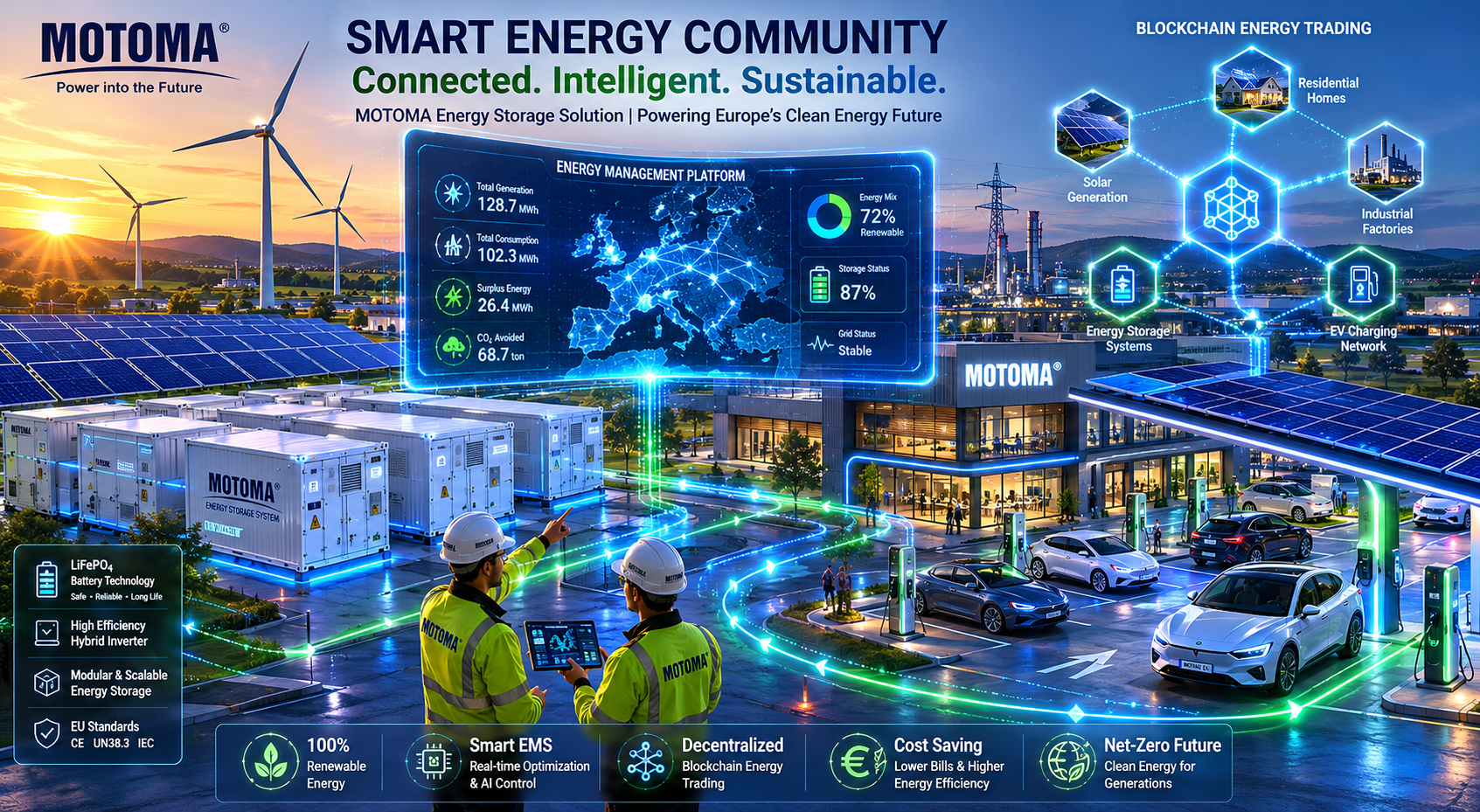
Imagine an industrial park in Germany on a sunny summer afternoon.
The rooftop solar system is producing more electricity than the factories can consume. Meanwhile, dozens of electric vehicles are parked outside charging stations, and a 500kWh battery storage system is already nearly full.
Traditionally, surplus electricity would either be exported to the grid at a low feed-in tariff or partially curtailed. At the same time, another nearby facility might still be purchasing electricity from the utility at a significantly higher price.
This mismatch between energy production and energy demand has become one of the major challenges facing Europe‘s energy transition.
Increasingly, engineers are asking a different question:
Instead of relying on a centralized utility to coordinate every transaction, can battery storage systems, EV charging stations, solar assets, and consumers negotiate energy exchange automatically?
This is where blockchain-based energy management is beginning to attract attention.
Why Traditional Energy Management Is Reaching Its Limits
Most distributed energy systems today still depend on centralized control platforms.
Whether managing a solar farm, battery energy storage system (BESS), EV charging network, or microgrid, decisions are usually made through a single supervisory platform.
This approach works reasonably well when the number of energy assets is limited.
However, Europe‘s energy landscape is changing rapidly:
- Thousands of rooftop PV systems are connected every month.
- Commercial battery installations continue to increase.
- Public and private EV charging networks are expanding.
- Vehicle-to-Grid (V2G) technology is entering pilot deployment.
- Energy communities are emerging across EU member states.
As distributed energy resources multiply, centralized coordination becomes increasingly complex and costly.
What Does Blockchain Add to an Energy System?
In practical energy applications, blockchain is not primarily about cryptocurrency.
Its value lies in creating a transparent and trusted transaction layer between multiple energy participants.
Every kilowatt-hour generated, stored, purchased, sold, or discharged can be automatically recorded and verified through smart contracts.
| Traditional Energy Model | Blockchain Energy Model |
|---|---|
| Centralized operator decisions | Distributed automated transactions |
| Manual settlement | Smart contract settlement |
| Limited peer-to-peer trading | Direct local energy exchange |
| Single control point | Distributed control architecture |
| Delayed transaction verification | Near real-time verification |
For microgrids and commercial energy parks, this creates opportunities for more flexible energy optimization.
A Practical Architecture for Decentralized Energy Systems
A modern decentralized energy system typically combines four major components:
| Component | Typical Specification | Function |
|---|---|---|
| Solar PV Array | 50kW – 5MW | Renewable generation |
| Hybrid Inverter | 30kW, 50kW, 100kW, 250kW | Energy conversion and control |
| Battery Storage System | 100kWh – 10MWh | Energy buffering and load shifting |
| EV Charging Network | 7kW, 11kW, 22kW, 60kW, 120kW | Flexible energy consumption |
The blockchain layer operates above these physical assets.
Instead of centrally instructing every device, the system publishes energy availability, pricing signals, battery state of charge (SOC), charging demand, and grid conditions.
Smart contracts then determine how energy should be allocated.
How Battery Storage Becomes an Active Market Participant
Historically, battery energy storage systems simply charged and discharged based on predefined schedules.
Under a decentralized framework, storage assets become active economic participants.
Consider a 1MWh LiFePO4 battery operating at:
- 512V DC architecture
- 600V DC architecture
- 768V DC architecture
- 100kW PCS
- 250kW PCS
- 500kW PCS
Instead of following fixed charging windows, the storage controller evaluates:
- Local electricity prices
- Solar production forecasts
- EV charging demand forecasts
- Grid congestion signals
- Demand response opportunities
The battery can then decide whether it is economically preferable to:
- Store excess solar energy
- Supply nearby EV chargers
- Support local microgrid loads
- Export power to the utility grid
- Participate in ancillary services markets
Why EV Charging Networks Are a Critical Piece of the Puzzle
Electric vehicles represent one of the largest flexible loads entering modern energy systems.
Unlike industrial machinery, EV charging can often be shifted within several hours without affecting user experience.
This flexibility creates valuable opportunities.
| Scenario | Energy Optimization Strategy |
|---|---|
| Midday solar surplus | Prioritize EV charging |
| Evening peak pricing | Delay non-essential charging |
| Grid congestion | Use battery storage support |
| Emergency outage | Enable V2G support |
In future implementations, thousands of connected EVs could collectively act as a distributed storage network.
Vehicle batteries ranging from 40kWh to 120kWh may become temporary energy resources available to local energy communities.
The European Opportunity
Europe provides a particularly favorable environment for decentralized energy management.
Several market trends are converging:
- Rapid EV adoption
- Growing renewable penetration
- Time-of-use electricity tariffs
- Energy community regulations
- Grid flexibility incentives
- Carbon reduction targets
Countries such as Germany, the Netherlands, Denmark, Spain, Italy, and France are already deploying pilot projects that combine battery storage systems, renewable generation, and smart charging infrastructure.
For EPC companies, system integrators, and energy developers, understanding how decentralized energy architecture may evolve is becoming increasingly relevant when designing future-ready projects.
From Hardware Deployment to Energy Coordination
The next phase of the energy transition may not be defined solely by larger batteries or more solar panels.
The real challenge is coordination.
A battery storage system, an EV charging network, a hybrid inverter, and a rooftop solar installation already contain most of the hardware required for a flexible energy ecosystem.
Blockchain-based energy management introduces a digital framework that allows these assets to cooperate autonomously, improving renewable energy utilization while reducing operational complexity.
For engineers designing Europe‘s future microgrids and distributed energy systems, the question is no longer whether decentralized energy networks are technically possible. The question is how quickly the market will adopt them.
Frequently Asked Questions
1. What is blockchain energy management?
Blockchain energy management uses distributed ledger technology and smart contracts to automate energy transactions between distributed energy resources, storage systems, and consumers.
2. Can battery storage systems participate in blockchain energy trading?
Yes. Modern battery energy storage systems can automatically buy, sell, store, or dispatch electricity according to predefined smart contract rules.
3. How does blockchain improve EV charging networks?
It enables transparent billing, peer-to-peer energy trading, demand response participation, and automated settlement between charging operators and energy providers.
4. What battery technologies are suitable for decentralized energy systems?
LiFePO4 battery storage systems are currently the most widely deployed option due to their safety, cycle life, and scalability.
5. Can decentralized energy systems operate during grid outages?
Yes. Combined with microgrid controllers, hybrid inverters, and battery storage, decentralized systems can continue supplying critical loads during outages.
6. What battery sizes are commonly used in commercial projects?
Typical installations range from 100kWh and 215kWh systems to multi-megawatt-hour storage plants exceeding 5MWh or 10MWh capacity.
7. Is blockchain required for every battery storage project?
No. However, it becomes increasingly valuable when multiple distributed assets and energy trading participants need secure and automated coordination.