
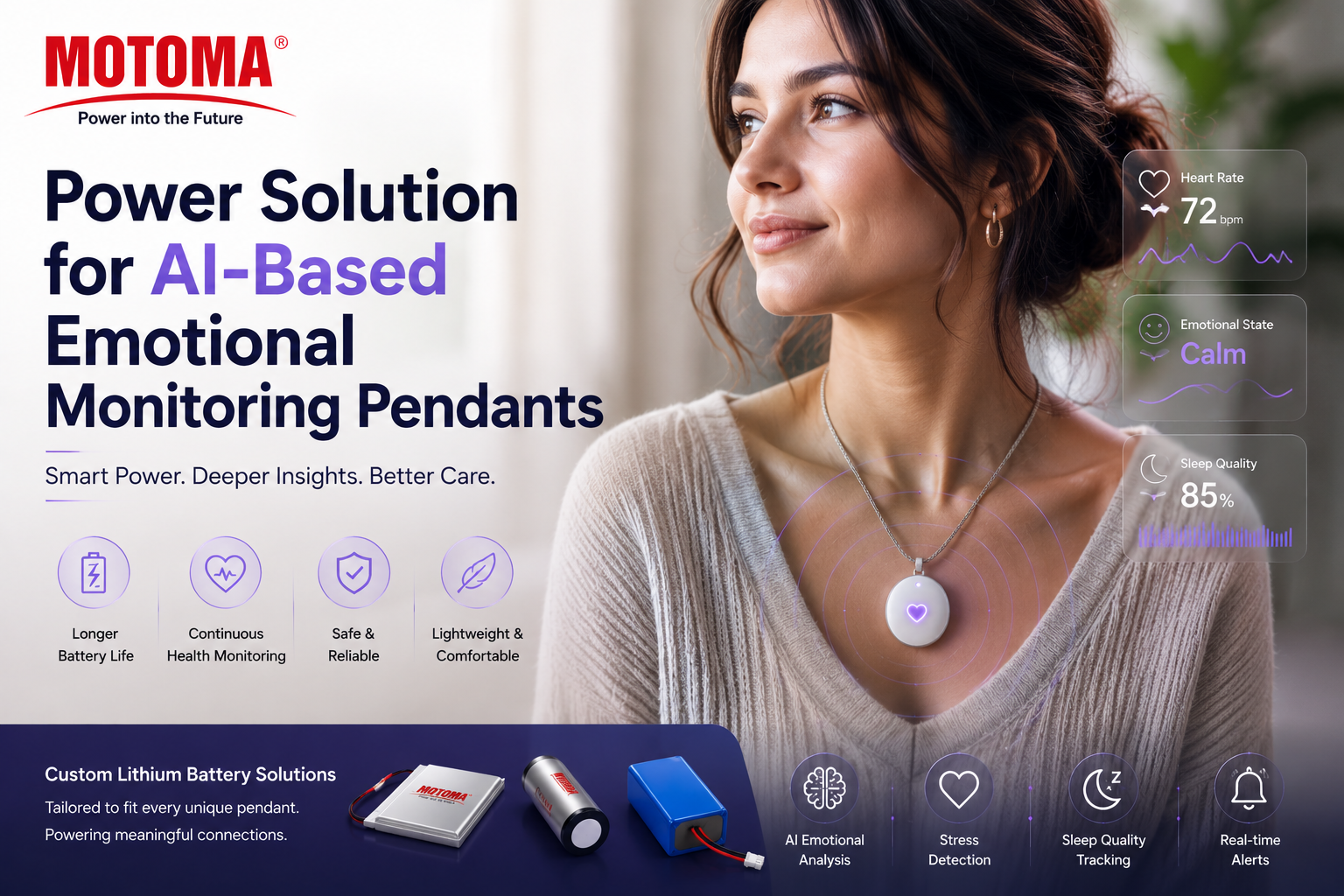
Power Solution for AI-Based Emotional Monitoring Pendants — CES 2026 Outlook
At CES 2026, emotional health wearables moved further toward jewelry-style form factors. For intelligent emotion monitoring pendants, where total device weight is typically limited to under 15 grams, the power system becomes one of the most demanding engineering constraints. The battery must deliver continuous sensing capability while remaining nearly invisible in both size and presence.
Based on current CES trends and production-ready technology, customized lithium polymer batteries remain the most practical solution for balancing energy density, safety, and industrial scalability in this category.
1. Core Battery Architecture: Ultra-Thin and Custom-Shaped Li-Polymer Cells
Advances in silicon–carbon anode technology have significantly improved volumetric energy density, enabling meaningful runtime within extremely thin profiles.
- Ultra-thin stacked construction: Recent CES demonstrations from manufacturers such as MOTOMA show lithium polymer cells with thicknesses ranging from 0.4 mm to 1.0 mm. These cells can be laminated directly onto the inner surface of ceramic or resin housings, allowing decorative shells to double as structural support.
- Optimized capacity for continuous sensing: Typical capacity ranges from 30 mAh to 80 mAh, sufficient to support always-on biosignal acquisition while preserving a lightweight, jewelry-grade form factor.
- High-voltage Li-Polymer platforms: Using 4.45V to 4.5V charging systems instead of conventional 4.2V designs improves usable energy density by approximately 15%, extending operating time without increasing cell size.
2. Charging Strategy: Wireless Simplicity and Auxiliary Energy Recovery
Physical charging ports are increasingly removed from next-generation pendants to improve water resistance and aesthetic consistency.
- NFC Wireless Charging 2.0: With wider adoption of NFC Forum WLC 2.0 standards highlighted at CES 2026, pendants can be charged directly from smartphones supporting reverse wireless charging. A shared NFC antenna handles both communication and power transfer, minimizing internal component count.
- Supplementary energy harvesting: Thin auxiliary cells, inspired by semi-solid designs, allow micro-level energy recovery from body movement or thermal gradients. While not a primary power source, this approach can extend standby time by approximately 10%, ensuring emergency emotional alerts remain available at low charge levels.
3. Intelligent Power Management: Emotion-Aware Energy Allocation
Power management in 2026 pendants is tightly coupled with AI-driven context awareness.
- Context-aware power scaling: During sleep or low-activity periods, the system shifts into microamp-level standby modes, maintaining only essential biosignal monitoring. When elevated stress indicators such as sudden HRV changes are detected, the battery system supports millisecond-level wake-up for full AI processing.
- Low-temperature protection and preheating: To maintain performance in cold environments, micro heating films are integrated to gently warm the battery when necessary, ensuring stable output during outdoor activities such as winter sports.
4. Safety Design for On-Body Wear
Since emotional monitoring pendants remain in direct contact with the body, battery safety is addressed at both material and system levels.
- Ceramic-coated separators: These reduce the risk of internal short circuits caused by impact or compression, providing an additional layer of protection for wearable use.
- Multi-layer PCM integration: Overcharge, over-discharge, and short-circuit protections are implemented with minimal footprint, ensuring compliance without sacrificing space.
5. Reference Power Specifications for Emotion Monitoring Pendants (2026)
| Parameter | 2026 Reference Range | Design Value |
|---|---|---|
| Battery Thickness | 0.4 mm – 1.2 mm | Maintains lightweight, jewelry-style comfort |
| Volumetric Energy Density | 750 – 850 Wh/L | Supports multi-day continuous emotion monitoring |
| Charging Method | NFC Wireless Charging 2.0 (1–3 W) | Enables fully sealed, port-free design |
| Safety Structure | Ceramic-coated separator | Improves impact resistance and user safety |
For OEMs developing intelligent emotional monitoring pendants, lithium polymer batteries remain the most adaptable and manufacturable option. When combined with ultra-thin stacking, wireless charging, and context-aware power management, they provide a stable energy foundation for discreet, always-on emotional health devices showcased at CES 2026.