
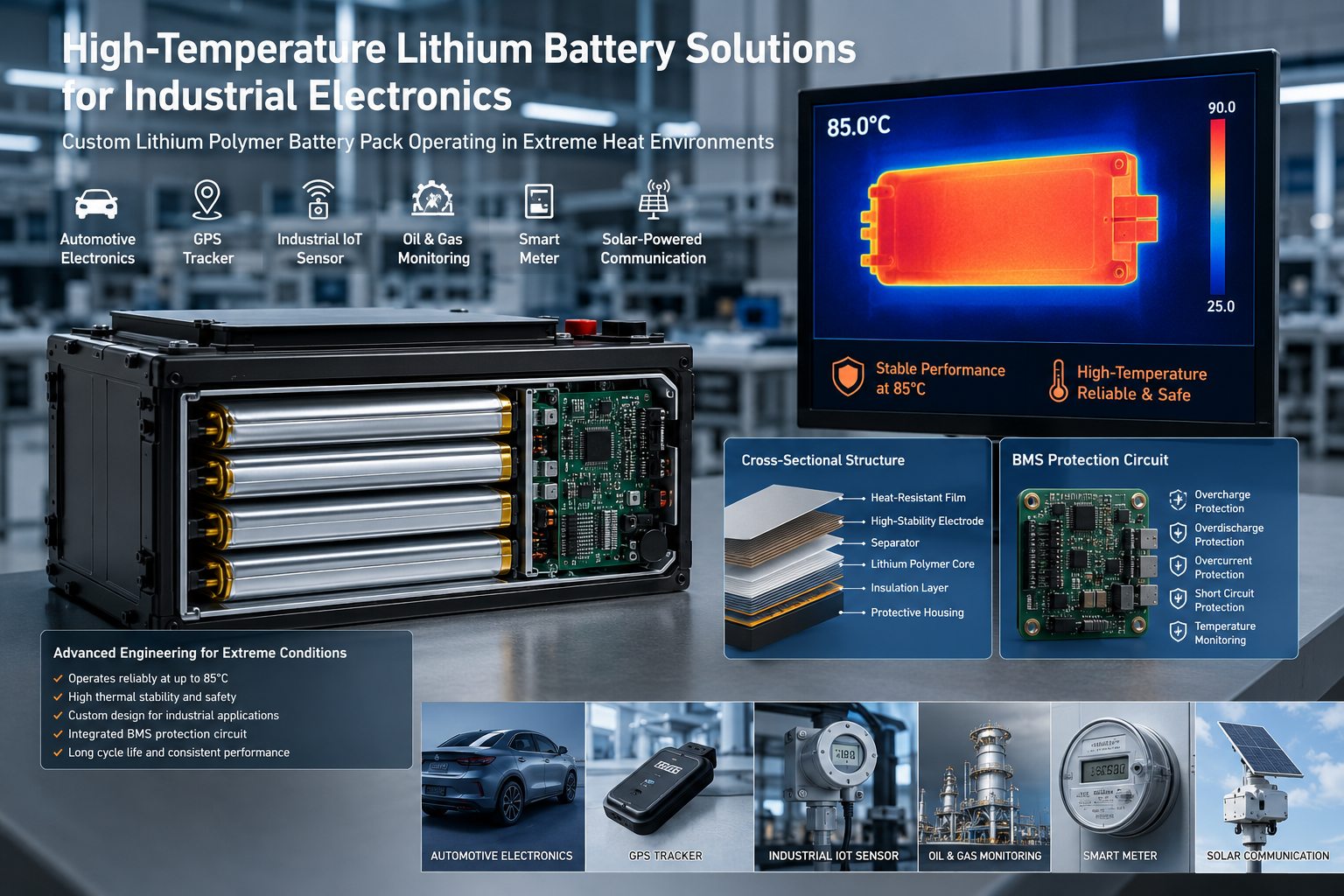
In battery engineering, most lithium batteries are designed to operate comfortably between 0°C and 45°C during charging and between -20°C and 60°C during discharge. However, many real-world applications do not operate in comfortable laboratory environments.
Electronic devices installed inside vehicles parked under direct sunlight, industrial monitoring systems mounted near machinery, oil and gas field instruments, solar-powered communication equipment, and outdoor IoT terminals may all experience temperatures exceeding 60°C, 70°C, or even 85°C.
Under these conditions, conventional lithium-ion batteries often suffer from accelerated aging, capacity loss, swelling, shortened cycle life, or safety concerns. This is where high temperature lithium battery solutions become essential.
For product managers, purchasing teams, electronic engineers, and industrial equipment manufacturers, selecting the correct high-temperature rechargeable battery can significantly improve product reliability and reduce maintenance costs throughout the product lifecycle.
What Is a High Temperature Lithium Battery?
A high temperature lithium battery is a specially designed lithium-ion battery, lithium polymer battery, Li-ion battery pack, or rechargeable battery pack engineered to operate safely and reliably in elevated temperature environments.
Compared with conventional batteries, high-temperature battery solutions typically incorporate:
- High thermal stability cathode materials
- Special electrolyte formulations
- Low gas-generation chemistry systems
- High-temperature separator materials
- Enhanced cell sealing technology
- Advanced battery management protection circuits
- Heat-resistant packaging structures
Depending on application requirements, some customized battery packs can support continuous operation at temperatures ranging from 60°C to 85°C, while certain industrial solutions can tolerate short-term exposure above 100°C.
Why Standard Lithium Batteries Struggle in High Temperature Environments
Many device manufacturers underestimate the impact of heat on battery performance.
| Temperature Condition | Potential Battery Impact |
|---|---|
| 45°C | Accelerated aging begins |
| 60°C | Noticeable capacity degradation |
| 70°C | Electrolyte decomposition risk increases |
| 85°C+ | Cell swelling and cycle life reduction |
| 100°C+ | Specialized industrial battery design required |
When batteries operate under prolonged high temperatures, chemical reactions inside the cell accelerate significantly. This leads to:
- Reduced cycle life
- Capacity fading
- Higher self-discharge rates
- Gas generation and swelling
- Increased internal resistance
- Safety concerns under charging conditions
For equipment expected to operate continuously in harsh environments, battery selection should be considered at the earliest design stage.
Common Voltage and Capacity Configurations
High-temperature lithium battery solutions are available in various voltage and capacity combinations depending on equipment requirements.
| Battery Voltage | Typical Capacity Range | Application Examples |
|---|---|---|
| 3.7V / 3.8V / 3.85V / 3.87V / 3.88V | 100mAh – 10000mAh | GPS Trackers, Sensors, IoT Devices |
| 7.4V | 1000mAh – 15000mAh | Portable Industrial Equipment |
| 11.1V | 2000mAh – 20000mAh | Inspection Systems, Communication Devices |
| 14.8V | 5000mAh – 30000mAh | Industrial Monitoring Equipment |
Depending on available installation space, battery packs may utilize cylindrical cells, pouch cells, lithium polymer cells, or custom-shaped battery assemblies.
Key Applications for High Temperature Lithium Batteries
1. Vehicle Telematics and GPS Tracking Systems
Vehicle-mounted electronics frequently experience internal temperatures exceeding 70°C during summer months.
Fleet management systems, asset trackers, vehicle cameras, OBD devices, and logistics monitoring equipment require batteries capable of maintaining stable performance despite extreme cabin temperatures.
Common battery configurations include:
- 3.7V 500mAh lithium polymer battery
- 3.85V 1000mAh rechargeable battery
- 7.4V 2000mAh custom battery pack
2. Oil and Gas Monitoring Equipment
Downhole sensors, pipeline monitoring systems, and exploration instruments often operate in environments where temperatures can exceed 85°C.
These applications demand batteries with exceptional thermal stability, low self-discharge characteristics, and long operational lifetimes.
3. Smart Utility Meters
Smart electricity meters, gas meters, and water meters installed outdoors are continuously exposed to direct sunlight and seasonal temperature fluctuations.
High-temperature lithium battery packs help ensure reliable data transmission and extended service intervals.
4. Industrial IoT Devices
Factory automation sensors, machine condition monitoring systems, industrial gateways, and wireless monitoring equipment frequently operate near heat-generating machinery.
Temperature-resistant battery solutions improve reliability and reduce maintenance requirements.
5. Solar-Powered Remote Systems
Solar street lights, remote communication terminals, agricultural monitoring devices, weather stations, and environmental monitoring equipment often experience both high temperatures and continuous charging cycles.
A properly designed high-temperature lithium battery paired with solar charging electronics can significantly extend operational life.
6. Automotive Electronics
Modern vehicles incorporate numerous electronic modules including TPMS sensors, emergency communication systems, smart dashboards, ADAS modules, and telematics control units.
Many of these systems require batteries capable of withstanding temperatures between 70°C and 85°C for extended periods.
Critical Design Considerations for High Temperature Battery Projects
Selecting a high-temperature battery involves more than simply choosing a cell with a higher temperature rating.
| Design Factor | Engineering Importance |
|---|---|
| Cell Chemistry | Determines thermal stability and cycle life |
| Battery Protection Circuit | Prevents overcharge and overheating |
| Mechanical Structure | Controls swelling and vibration resistance |
| Thermal Management | Reduces internal heat accumulation |
| Charging Strategy | Protects battery lifespan at elevated temperatures |
| Certification Compliance | Supports market entry and transportation approval |
MOTOMA High Temperature Lithium Battery Solutions
MOTOMA provides customized high-temperature lithium battery solutions for industrial electronics, telematics systems, smart devices, automotive electronics, communication equipment, and specialized IoT applications.
Our engineering support includes:
- Custom lithium polymer battery design
- Custom lithium-ion battery pack assembly
- 3.7V, 3.8V, 3.85V, 3.87V, 3.88V battery solutions
- 7.4V, 11.1V, 14.8V multi-cell battery packs
- 100mAh to 30000mAh capacity customization
- Wide-temperature charging and discharging solutions
- Intelligent PCM and BMS integration
- Connector and wiring harness customization
- UN38.3, IEC62133, CE, RoHS compliant solutions
- OEM and ODM battery development support
Every application presents unique environmental challenges. Therefore, battery selection should always consider actual operating temperature, charging behavior, installation constraints, communication requirements, and expected service life.
Conclusion
As electronic devices continue moving into harsher environments, battery performance at elevated temperatures becomes increasingly important.
Whether developing vehicle telematics devices, industrial sensors, GPS trackers, solar-powered equipment, smart meters, or automotive electronics, selecting a properly engineered high-temperature lithium battery can improve reliability, reduce maintenance costs, and support long-term product stability.
The most effective solution is not necessarily the highest-capacity battery. It is the battery specifically designed to operate reliably within the real environmental conditions of the target application.
Frequently Asked Questions
1. What temperature can a high-temperature lithium battery withstand?
Most high-temperature lithium batteries support continuous operation between 60°C and 85°C, depending on cell chemistry and system design.
2. Can lithium polymer batteries operate in hot environments?
Yes. Specially designed lithium polymer batteries with high-temperature electrolyte systems and thermal-resistant materials can perform reliably in elevated temperatures.
3. Which industries commonly use high-temperature batteries?
Automotive electronics, GPS tracking, industrial IoT, oil and gas monitoring, smart metering, communication equipment, and solar-powered devices are common applications.
4. Is charging allowed at high temperatures?
Charging limits depend on battery chemistry and manufacturer specifications. High-temperature charging solutions generally require specialized charging management and protection systems.
5. What voltage options are available for custom high-temperature battery packs?
Common options include 3.7V, 3.8V, 3.85V, 3.87V, 3.88V, 7.4V, 11.1V, and 14.8V battery configurations.
6. What capacities are available?
Custom solutions can range from 100mAh micro batteries to industrial battery packs exceeding 30000mAh depending on application requirements.
7. How can I choose the right high-temperature battery for my project?
Evaluate operating temperature, discharge current, installation space, charging conditions, certification requirements, and target service life before selecting a battery solution.