
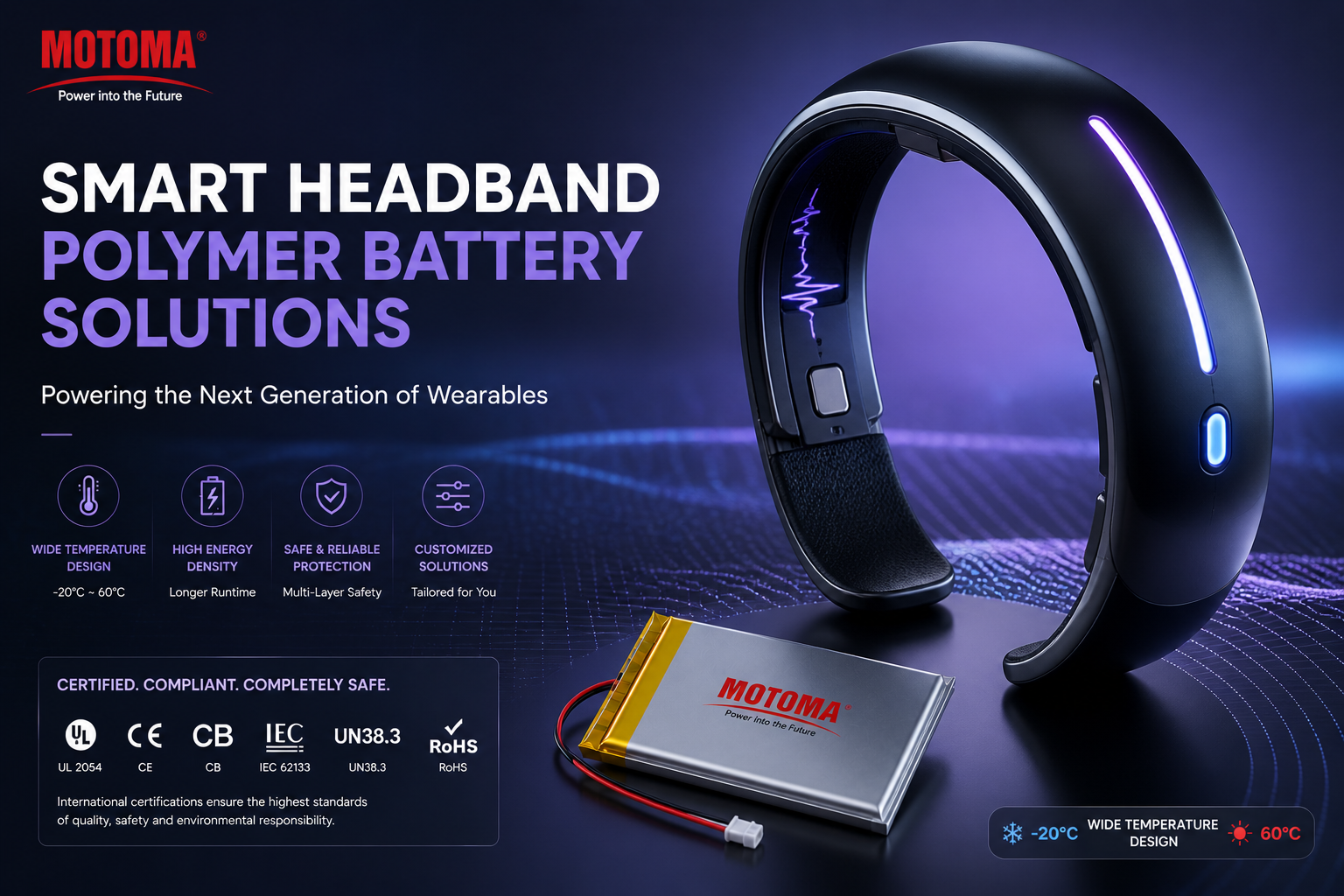
At CES 2026, smart headbands moved beyond sleep tracking accessories and entered a more technical category: consumer-grade brain-computer interface (BCI) devices. From EEG-assisted sleep optimization to neurofeedback gaming and real-time cognitive monitoring, these products are now expected to process millisecond-level neural data while maintaining lightweight comfort for long-duration wear.
For product managers, structural engineers, and electronics design teams, this creates a familiar challenge: how do you integrate enough battery capacity into a head-worn device without compromising comfort, heat dissipation, flexibility, or safety?
This is where custom lithium polymer battery pack design becomes critical. Traditional rigid lithium-ion cells no longer fit emerging smart wearable architectures. Flexible lithium polymer batteries, curved pouch cells, and ultra-thin rechargeable LiPo battery packs are becoming the practical path forward.
Why Battery Architecture Matters for Smart Headband Design
| Design Requirement | Battery Engineering Challenge | MOTOMA Solution |
|---|---|---|
| 24-hour wearability | Weight distribution imbalance | Curved split-cell architecture |
| EEG sensor precision | Thermal interference | Low-heat discharge platform |
| Slim textile integration | Limited internal space | 0.5mm–1.5mm ultra-thin LiPo cells |
| Fast recharge | Heat accumulation | Controlled 3C–5C charging design |
| Safety near skin | Pressure deformation risk | Ceramic-coated separator + gel electrolyte |
Recommended Battery Voltage Platforms for Smart Headbands
Different smart headband applications require different voltage and capacity strategies.
| Application | Battery Voltage | Typical Capacity | Cell Format |
|---|---|---|---|
| Sleep monitoring band | 3.7V / 3.8V | 250mah – 500mah | Flexible curved pouch |
| EEG meditation device | 3.85V / 3.87V | 300mah – 600mah | Ultra-thin LiPo |
| Neurofeedback gaming headset | 7.4V | 800mah – 1500mah | Dual-cell custom pack |
| Advanced AI BCI wearable | 11.1V / 14.8V | 1000mah – 5000mah | High-rate modular battery |
Flexible Battery Form Factors Defining CES 2026
1. Curved Lithium Polymer Cells
Curved rechargeable lithium polymer batteries are designed to match headband contours. Instead of concentrating weight at the forehead, battery modules can be distributed across both sides or rear sections.
Typical specs:
3.7V 300mah curved LiPo
3.85V 500mah flexible battery
3.88V 800mah arc pouch cell
2. Ultra-Thin Flexible Battery Packs
For textile-integrated wearables, thickness matters more than absolute capacity. Cells between 0.5mm and 1.2mm allow direct embedding into smart fabrics.
3. High-Voltage Compact Packs
BCI gaming or audio-feedback systems with local AI acceleration often require 7.4V, 11.1V, or 14.8V battery packs for stable processor performance.
Thermal Stability: The Overlooked Design Constraint
Unlike wrist-worn wearables, smart headbands remain in direct contact with skin for hours. A battery surface temperature increase of even 2–3°C can impact user comfort and EEG signal quality.
MOTOMA custom battery systems integrate:
- Ceramic-coated separator structures
- Low-resistance tab architecture
- Thermal balancing layout
- Smart BMS temperature feedback
Fast Charging Without User Discomfort
CES 2026 highlighted growing demand for rapid top-up charging. Users expect:
- 10-minute charging for overnight sleep sessions
- 15-minute charging for daytime neurotraining
- Wireless magnetic charging docks
Recommended charging strategy:
| Battery Capacity | Charging Input | Recovery Time |
|---|---|---|
| 300mah | 5W | 15 min |
| 500mah | 10W | 18 min |
| 1000mah | 15W | 25 min |
Key Selection Criteria for B2B Device Manufacturers
When sourcing a custom lithium polymer battery for smart headband projects, engineering teams should evaluate:
- Cycle life under wearable duty cycles
- Compression resistance
- Bending tolerance
- Heat generation at peak discharge
- Cell consistency for EEG stability
- UN38.3 / IEC62133 / RoHS compliance
How MOTOMA Supports Smart Wearable Battery Development
MOTOMA provides custom rechargeable lithium polymer battery solutions for:
- 3.7V / 3.8V / 3.85V smart wearable batteries
- Flexible pouch battery development
- Curved battery structural customization
- Fast-charging battery pack design
- Low-temperature-rise wearable battery systems
From 100mah micro wearable cells to 5000mah intelligent device battery packs, our engineering team supports battery integration from concept validation through mass production.
Final Engineering Perspective
The future of smart headbands is not only about EEG algorithms or AI software. Battery architecture will increasingly determine product comfort, runtime, safety, and commercial viability.
For 2026 wearable neurotechnology products, flexible lithium polymer battery design is no longer optional—it is part of the product experience itself.