

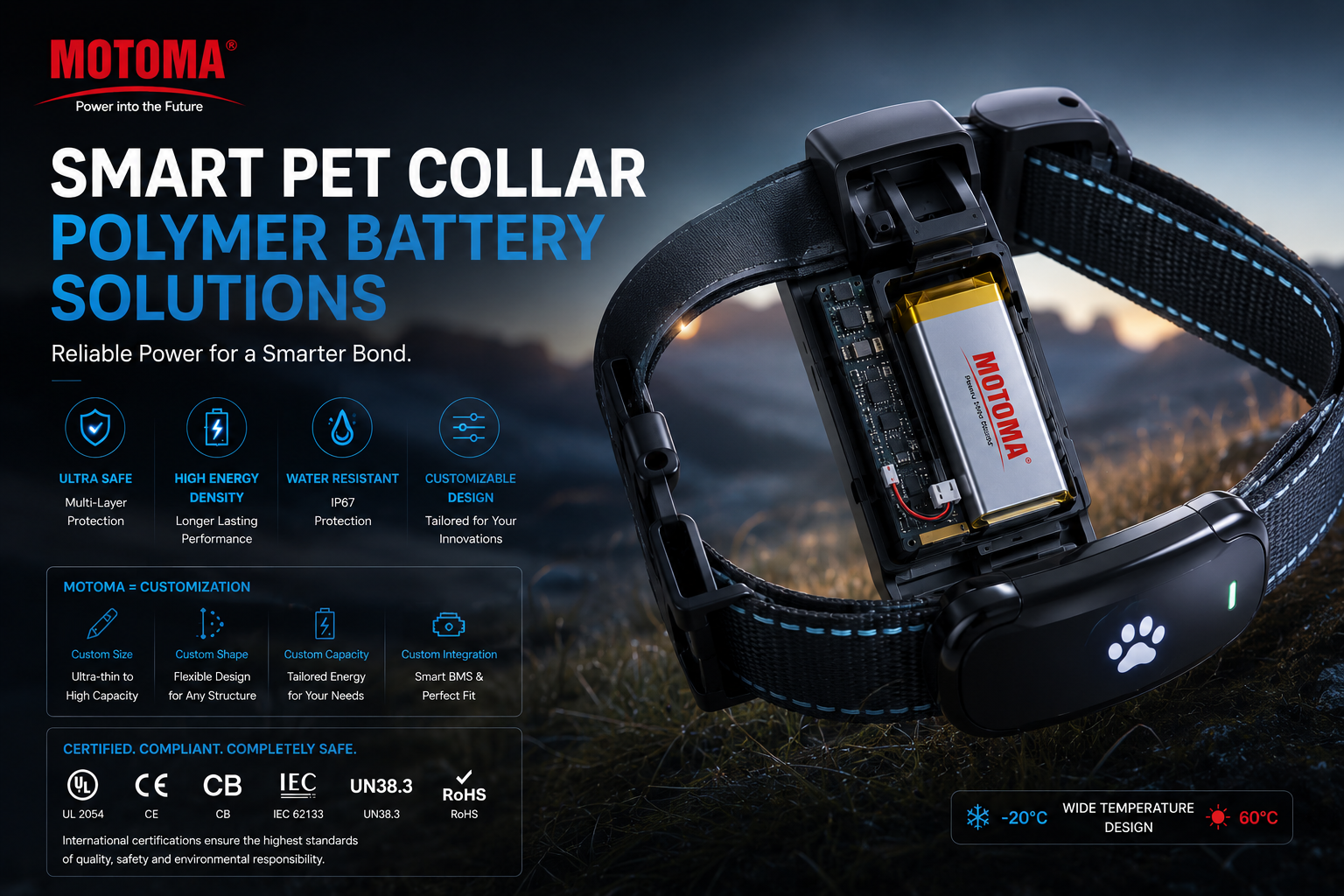
At CES 2026, smart pet collars moved well beyond location tracking. The category is evolving into a connected wearable platform combining biometric sensing, behavioral analysis, geofencing, edge AI processing, and always-on communication.
For electronics developers, this shift introduces a familiar challenge: how do you fit more sensing capability, stronger wireless connectivity, and longer runtime into a device small enough for daily wear?
The answer increasingly comes down to battery architecture. Across this year’s product launches, custom lithium polymer battery packs — including 3.7V LiPo battery, 3.8V pouch cell, 3.85V high-voltage lithium polymer battery, 4.48V smart wearable battery, and compact 7.4V battery modules — are becoming the preferred solution.
Why Smart Pet Collars Demand Different Battery Design Rules
Unlike standard wearable electronics, pet collars face several unique engineering constraints:
| Design Requirement | Battery Engineering Impact |
|---|---|
| 24/7 body contact | Strict thermal control and low surface heat |
| High-impact movement | Mechanical rigidity and anti-deformation structure |
| Outdoor exposure | Waterproof sealed charging architecture |
| Chewing / pressure resistance | Enhanced pouch protection layers |
| Ultra-light wearability | Flexible shaped-cell integration |
Traditional cylindrical batteries often struggle with these constraints. Custom polymer pouch cells allow collar designers to distribute power more evenly across the wearable structure.
Battery Trends Emerging from CES 2026
1. Shaped Silicon-Carbon Polymer Cells
Several smart collar platforms are now integrating arc-shaped and semi-flexible lithium polymer battery packs. These cells make use of silicon-carbon anode chemistry to improve volumetric efficiency.
Typical specifications include:
- 250mAh to 350mAh for GPS-focused tracking collars
- 400mAh to 500mAh for AI health monitoring systems
- 800mAh to 1000mAh for extended outdoor LPWAN applications
Voltage platforms commonly include 3.7V, 3.8V, 3.85V, and increasingly 4.48V high-voltage lithium polymer configurations.
2. Flexible Battery Geometry
Instead of centralized battery blocks, 2026 smart collars increasingly adopt:
- Crescent pouch cells
- Curved lithium polymer batteries
- Segmented multi-cell collar architecture
This reduces local pressure points while preserving battery capacity.
3. High-Voltage Instant Response
When AI systems detect irregular movement, seizure patterns, or escape events, the device must activate:
- High-frequency sensor sampling
- GNSS tracking
- Cellular/LPWAN transmission
- Emergency push notifications
A stable 4.48V or 7.4V discharge platform ensures voltage consistency under sudden load spikes.
Typical Battery Configurations for 2026 Smart Pet Collars
| Application Type | Battery Spec | Voltage | Runtime |
|---|---|---|---|
| Basic GPS Collar | 250mAh–300mAh | 3.7V / 3.8V | 30–60 days |
| AI Health Monitoring Collar | 350mAh–450mAh | 3.85V / 4.48V | 7–15 days |
| Medical Wearable Collar | 400mAh–500mAh | 3.87V / 3.88V | 14–21 days |
| Outdoor Tracking Collar | 800mAh–1000mAh | 7.4V | 6–12 months |
| Advanced Companion Robotics Collar | 1200mAh–2000mAh | 11.1V / 14.8V | Continuous hybrid operation |
Safety Matters More in Pet Wearables
Battery failure inside a pet collar is fundamentally different from failure in a handheld consumer device.
Mechanical abuse scenarios include:
- Biting pressure exceeding 400 lbs
- Repeated twisting
- Moisture ingress
- Impact during running or jumping
For this reason, next-generation smart collar battery packs increasingly use:
- Ceramic-coated separators
- Reinforced multi-layer pouch encapsulation
- Puncture-resistant composite outer films
- Low-temperature and high-temperature adaptive BMS
MOTOMA‘s Engineering Focus for Pet Wearable Battery Development
Battery development for pet wearable OEM projects requires balancing energy density with real-world mechanical reliability.
At MOTOMA, custom battery pack design begins with use-case modeling:
- Animal size and movement intensity
- Daily communication cycle
- Sensor load behavior
- Charging ecosystem integration
- Environmental exposure profile
Whether the requirement is:
- 3.7V 300mAh ultra-thin battery pack
- 3.85V 450mAh shaped pouch cell
- 7.4V 1000mAh outdoor GPS battery module
- 11.1V custom AI wearable battery system
the engineering objective remains the same: stable power delivery inside highly constrained wearable structures.
Frequently Asked Questions
Q1: Why are polymer batteries preferred for smart collars?
They allow flexible shapes, lighter weight, and better integration into wearable structures.
Q2: What voltage is most common?
3.7V, 3.8V and 3.85V dominate standard wearables, while 4.48V and 7.4V are growing for AI-intensive applications.
Q3: What capacity suits most smart collars?
250mAh–450mAh for daily wearable monitoring; 800mAh+ for extended GPS tracking.
Q4: How is charging typically handled?
Magnetic charging, NFC wireless charging, and sealed pogo-pin systems are common.
Q5: Are shaped batteries more expensive?
They involve custom tooling, but usually improve overall device efficiency and industrial design flexibility.
Q6: Can batteries survive chewing or impact?
With reinforced pouch film and ceramic safety layers, resistance to puncture and compression improves significantly.