
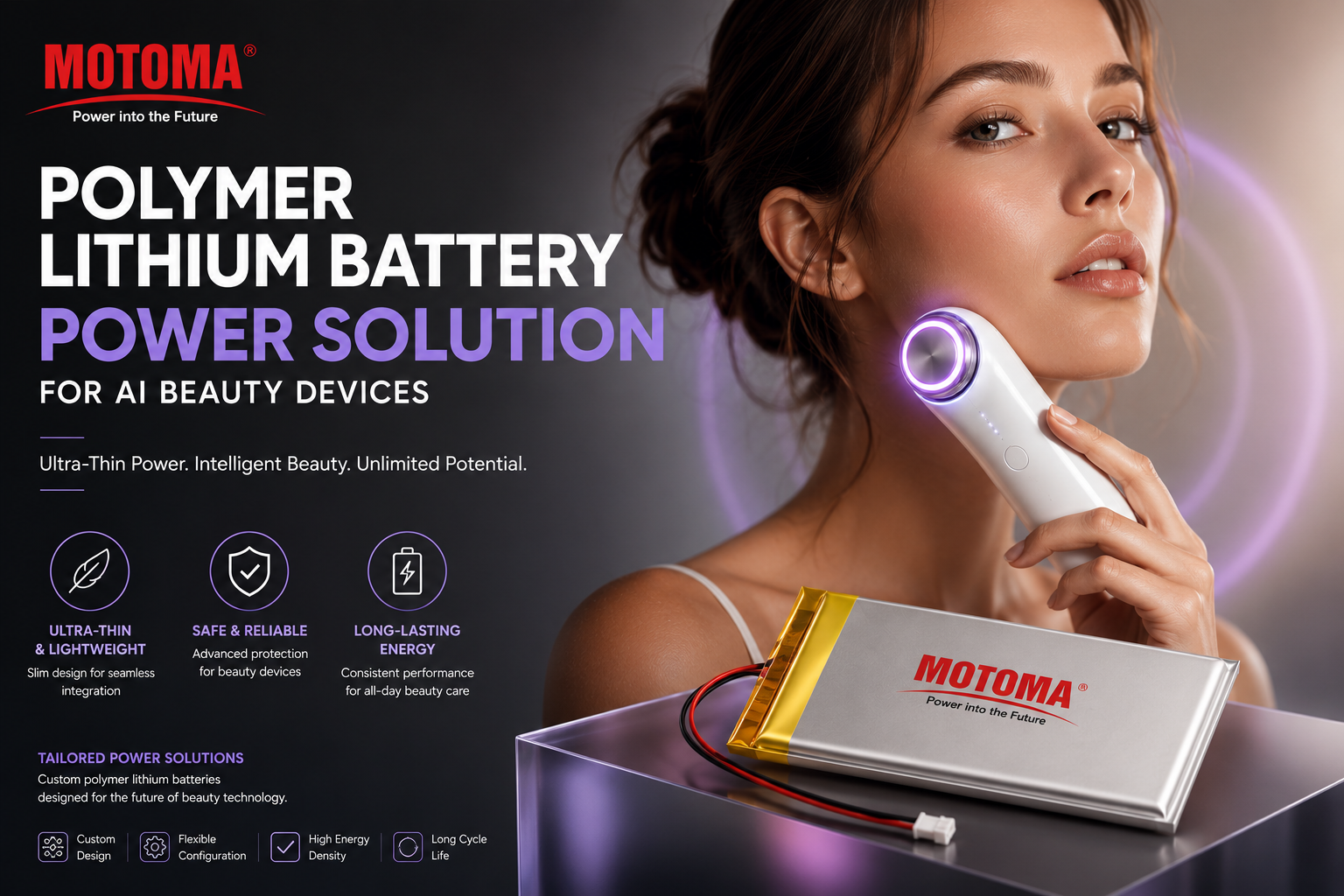
AI-driven beauty analyzers and smart cosmetic devices introduced around CES 2026 place unusually high demands on their power systems. These products must simultaneously drive high-brightness fill lights, high-resolution cameras, and real-time edge AI processing, while remaining lightweight, handheld, and capable of all-day or multi-day operation. This section outlines a polymer lithium battery solution aligned with current industry and product design trends.
1. Core Power Architecture: High Power Density with Fast Response
Most 2026-generation AI beauty devices adopt silicon–carbon anode polymer batteries to handle the elevated power consumption introduced by real-time image analysis and multi-sensor fusion.
- 4.5V high-voltage polymer system:
To support Mini-LED lighting arrays that simulate multiple lighting environments (office, warm indoor, daylight), the battery platform shifts from traditional 4.2V systems to a 4.5V architecture. This improves volumetric energy density by approximately 20%, enabling over 5 hours of continuous AI analysis in a smartphone-like form factor. - 10C pulse discharge capability:
During instantaneous activation of hyperspectral sensors and high-power fill lights, peak current demand rises sharply. Short-duration high-rate discharge support prevents voltage sag, ensuring stable AI inference without frame drops or system resets.
2. Energy Replenishment & Lifecycle Management
As device enclosures become fully sealed for water resistance and hygiene, traditional charging interfaces are being phased out.
- NFC WLC 2.0 wireless charging:
Following CES 2026 adoption of NFC-based wireless power transfer, handheld beauty analyzers typically support 2–3 W contactless charging via a desktop dock or even a compatible smartphone back panel. This enables sealed, connector-free industrial design. - Battery Longevity AI:
An onboard NPU continuously learns user behavior patterns. For example, if usage is concentrated during morning routines, the system maintains state-of-charge within an optimal 50%–80% window during idle hours. This adaptive charging strategy can extend cycle life to over 2000 cycles.
3. Typical Battery Specifications Reference (2026 Outlook)
Based on CES 2026 product directions such as AI beauty mirror modules and handheld skin analysis tools, the following battery specifications represent common design targets.
| Product Category | Typical Capacity | Battery Form | Key Parameters | Engineering Value |
|---|---|---|---|---|
| Handheld AI Skin Analyzer | 800 – 1200 mAh | Ultra-thin / Custom-shaped polymer | 350 Wh/kg, 3C fast charge | Lightweight design, supports 50+ in-depth scans per charge |
| Smart Beauty Analysis Mirror | 5000 – 8000 mAh | Large-area backplate polymer | 4.5V system, 2000 cycles | Cable-free installation with high-brightness ring lighting |
| Wearable Skin Patch | 30 – 60 mAh | Flexible curved polymer | <1 mm thickness, high flexibility | Comfortable adhesion for continuous UV and stress monitoring |
| Microfluidic Spray Analyzer | 1500 – 2000 mAh | Stacked high-rate polymer | 5C continuous discharge | Stable power for nano-scale skincare fluid delivery |
4. 2026 Power Solution Summary
- Form factor evolution: Battery geometry shifts from rectangular blocks toward thin, contoured, and asymmetric shapes to match ergonomic, biomimetic device designs.
- Safety engineering: Ceramic-coated separators are integrated to maintain thermal stability, even under high humidity, elevated temperature, or accidental drops commonly encountered in bathroom environments.
- Human–machine interaction: Battery health data is tightly linked to the AI assistant. When capacity fade is detected, the device proactively alerts the user to schedule a battery replacement to maintain diagnostic accuracy.