

Lithium Battery Connector Guide: How to Choose the Right Connector for a Battery Pack
A Lithium Battery Connector may be a small component, but it sits directly in the electrical path between a lithium-ion battery pack and the equipment it powers. A poorly matched connector can become a source of voltage drop, heat, intermittent contact or assembly errors. A properly selected connector, on the other hand, helps create a stable, serviceable and mechanically reliable battery system.
Choosing a connector is therefore about much more than finding two plugs that physically fit together. Engineers need to consider current, voltage, wire size, temperature rise, contact resistance, mating cycles, polarity protection, locking method and the environment in which the battery will operate.
What Is a Lithium Battery Connector?
A lithium battery connector is the electrical interface used to transfer power—and, in some battery designs, signals—between a lithium battery pack and another part of the system.
Depending on the application, the connector may carry only positive and negative power lines, or it may also include connections for temperature sensing, battery identification, communication, balancing or battery management system signals.
You can find lithium-ion battery connectors in products ranging from compact consumer electronics and medical devices to power tools, robotics, energy storage equipment, electric mobility products and industrial machines.
Why Does Lithium Battery Connector Selection Matter?
Battery pack designers naturally spend a great deal of time considering cell chemistry, capacity, discharge rate and the battery management system. The connector deserves similar attention because every ampere delivered by the pack must eventually pass through its electrical contacts.
1. Electrical resistance creates heat
No real connector has zero resistance. Contact resistance is normally very small, but at higher current levels even a small increase can become important.
Voltage Drop: V = I × R | Power Loss: P = I² × R
Because resistive heating increases with the square of current, the same connector that performs comfortably in a low-current device may not be appropriate for a high-discharge battery pack.
2. Connectors must remain mechanically secure
Portable equipment, power tools, mobile robots and industrial systems may experience vibration, pulling forces or repeated connection cycles. Mechanical latches, secondary locks and suitable terminal retention can become important in these environments.
3. Polarity mistakes can be serious
A polarized connector housing or mechanical keying feature helps prevent incorrect mating. This is especially useful when multiple similar connectors are installed in one product.
4. Serviceability matters
Some battery packs are expected to remain permanently installed. Others must be replaced, charged externally or disconnected during maintenance. The required mating cycle life should therefore be considered during connector selection.
Common Types of Lithium Battery Connectors
There is no single connector that is best for every lithium battery. Different connector architectures are optimized for different electrical, mechanical and packaging requirements.
| Connector Type | Typical Characteristics | Common Applications | Key Selection Point |
|---|---|---|---|
| Compact Wire-to-Board Connector | Small pitch, crimp terminals, compact housing and optional locking features. | Small electronics, portable instruments, smart devices and compact battery packs. | Current capability, pitch, wire gauge and retention. |
| Wire-to-Wire Locking Connector | Male and female housings with positive locking and crimp contacts. | Power tools, appliances, industrial equipment and replaceable packs. | Locking strength, vibration resistance and conductor size. |
| High-Current Polarized Connector | Larger contacts, strong polarity protection and relatively low resistance. | Robotics, RC applications, portable energy systems and higher-power battery packs. | Continuous current, peak current, thermal performance and mating cycles. |
| Battery-to-PCB Contact Connector | Spring contacts, blade contacts or direct battery interconnect structures. | Mobile electronics, handheld devices and integrated battery modules. | Contact force, working height, alignment and PCB layout. |
| Multi-Pin Power and Signal Connector | Carries battery power together with sensing, communication or identification signals. | Smart battery packs, medical equipment, industrial batteries and battery systems with communication. | Power-contact derating, signal isolation and pin assignment. |
| Bolted Terminal / Busbar Interface | Mechanical fastening rather than frequent plug-and-unplug operation. | Large battery modules, energy storage and high-current industrial systems. | Torque, contact area, insulation, creepage and service procedure. |
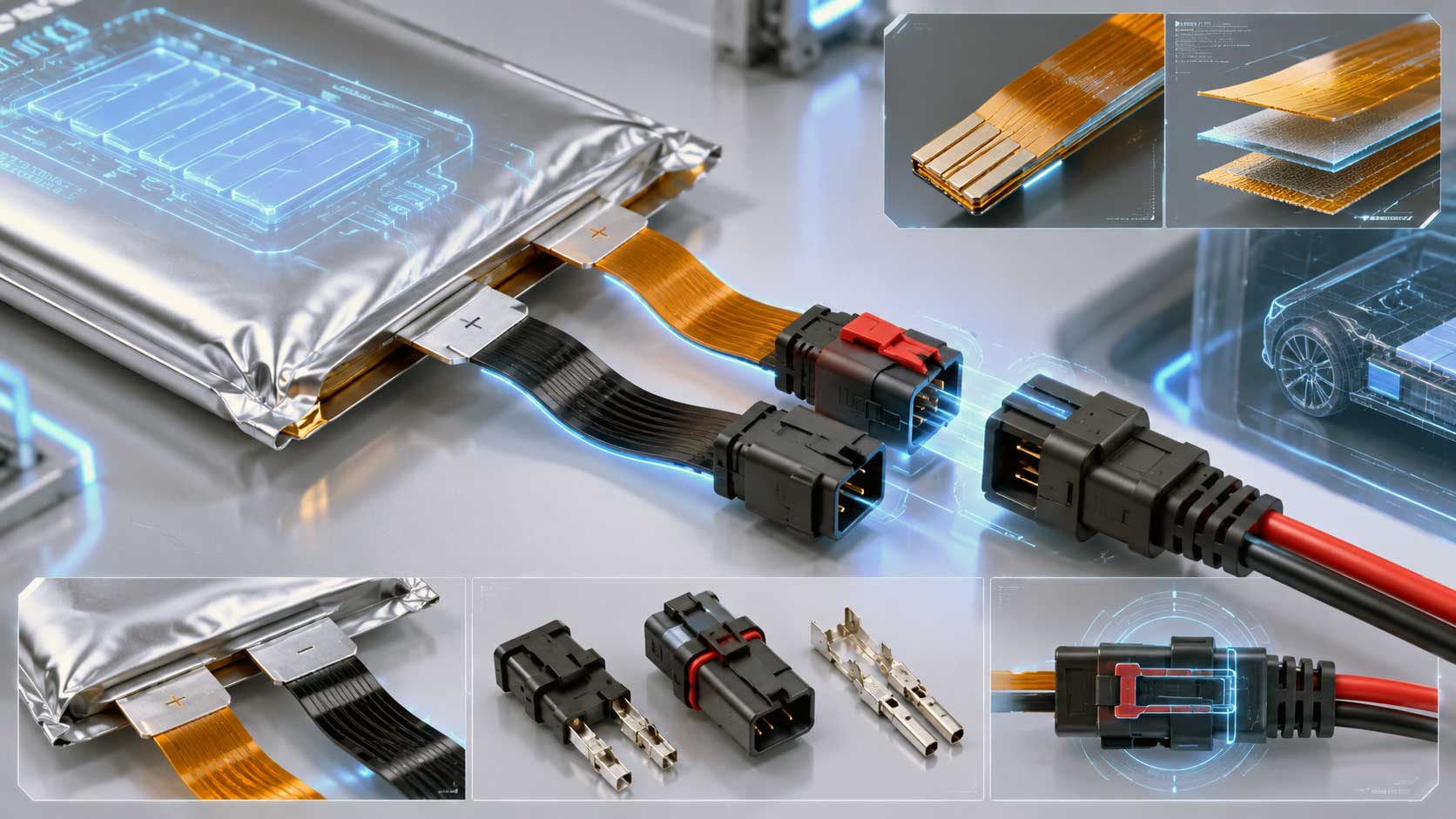
Engineering note: Connector families may look similar while having significantly different contact materials, terminal geometry, wire ranges and electrical ratings. Selection should be based on the exact manufacturer‘s specification rather than appearance alone.
How to Choose the Right Lithium Battery Connector
A practical lithium battery connector selection process begins with the electrical requirements and then adds mechanical, environmental and manufacturing constraints.
Step 1: Determine continuous and peak current
Start with the maximum current that can realistically pass through the connector. Do not look only at the battery‘s nominal capacity in amp-hours. Capacity and current are different parameters.
A 5 Ah battery, for example, could be used in either a low-current device or an application with relatively high discharge current. The connector must be selected for the actual electrical load.
Consider both:
- Normal continuous operating current
- Short-duration peak or surge current
- Charging current
- Possible fault conditions addressed by the protection system
Step 2: Check connector voltage rating
Connector voltage requirements become increasingly important as battery systems move from small single-cell packs to multi-series-cell battery modules.
Use the maximum fully charged pack voltage—not simply the nominal voltage— when reviewing system requirements.
Step 3: Match the connector to the wire gauge
Connector terminals are normally designed for a specified conductor range. Using wire outside that range can affect crimp quality, mechanical retention and electrical performance.
Wire insulation diameter also matters. Two wires with the same conductor size may use different insulation thicknesses.
Step 4: Review temperature and derating
Current ratings are meaningful only when their test conditions are understood. Ambient temperature, conductor size, contact arrangement, housing design and the number of loaded power contacts can all influence temperature rise.
For multi-contact battery connectors, do not simply multiply a single-contact current value by the total number of pins and assume that the result is the safe system current.
Step 5: Decide whether a locking connector is required
A friction-fit connection may be adequate for some internal, low-vibration products. Equipment exposed to movement or vibration may benefit from a positive latch or secondary locking feature.
Step 6: Add polarity protection and keying
Good battery connector design should make incorrect assembly difficult. Mechanical polarization, different keying positions or clearly differentiated housings can reduce wiring errors during manufacturing and servicing.
Step 7: Consider environmental exposure
Ask where the battery will actually operate. A connector used inside a dry consumer device faces very different conditions from one installed in an outdoor machine.
Possible environmental factors include:
- High or low operating temperature
- Humidity
- Condensation
- Dust
- Water exposure
- Oil or chemical exposure
- Salt atmosphere
- Vibration and mechanical shock
Contact Resistance: A Small Number That Matters
Contact resistance is one of the most useful parameters for understanding why connector quality matters in a battery system.
The electrical path is not just the visible metal contact. It includes the conductor, wire termination, crimp interface, mating contact surfaces and sometimes the PCB or busbar connection.
Over time, contamination, insufficient contact force, poor crimping, excessive mating wear or corrosion may increase resistance.
As resistance increases, voltage drop and heat can increase as well. This is why engineers should evaluate the complete terminated connection rather than selecting a connector only by housing size.
Lithium Battery Connector and Wire Gauge Must Be Selected Together
The connector and cable form one electrical system. Selecting them independently can lead to unnecessary limitations.
| Design Question | Why It Matters |
|---|---|
| What conductor size is required? | The terminal must accept the selected conductor and provide a stable electrical termination. |
| What is the insulation diameter? | Insulation support and housing entry dimensions must accommodate the cable. |
| Is the terminal crimped or soldered? | Each termination method requires the correct terminal design and process. |
| How much cable movement is expected? | Strain relief may be necessary to prevent repeated force from reaching the electrical termination. |
| Will several power contacts operate simultaneously? | Thermal interaction between loaded contacts may require current derating. |
Crimp quality is part of connector quality
Even a well-designed lithium battery connector can perform poorly if the terminal is incorrectly crimped.
In volume production, a controlled crimping process can be more important than simply choosing a well-known connector family. Terminal compatibility, conductor strip length, crimp height and pull-force verification should be defined according to the terminal manufacturer‘s requirements.
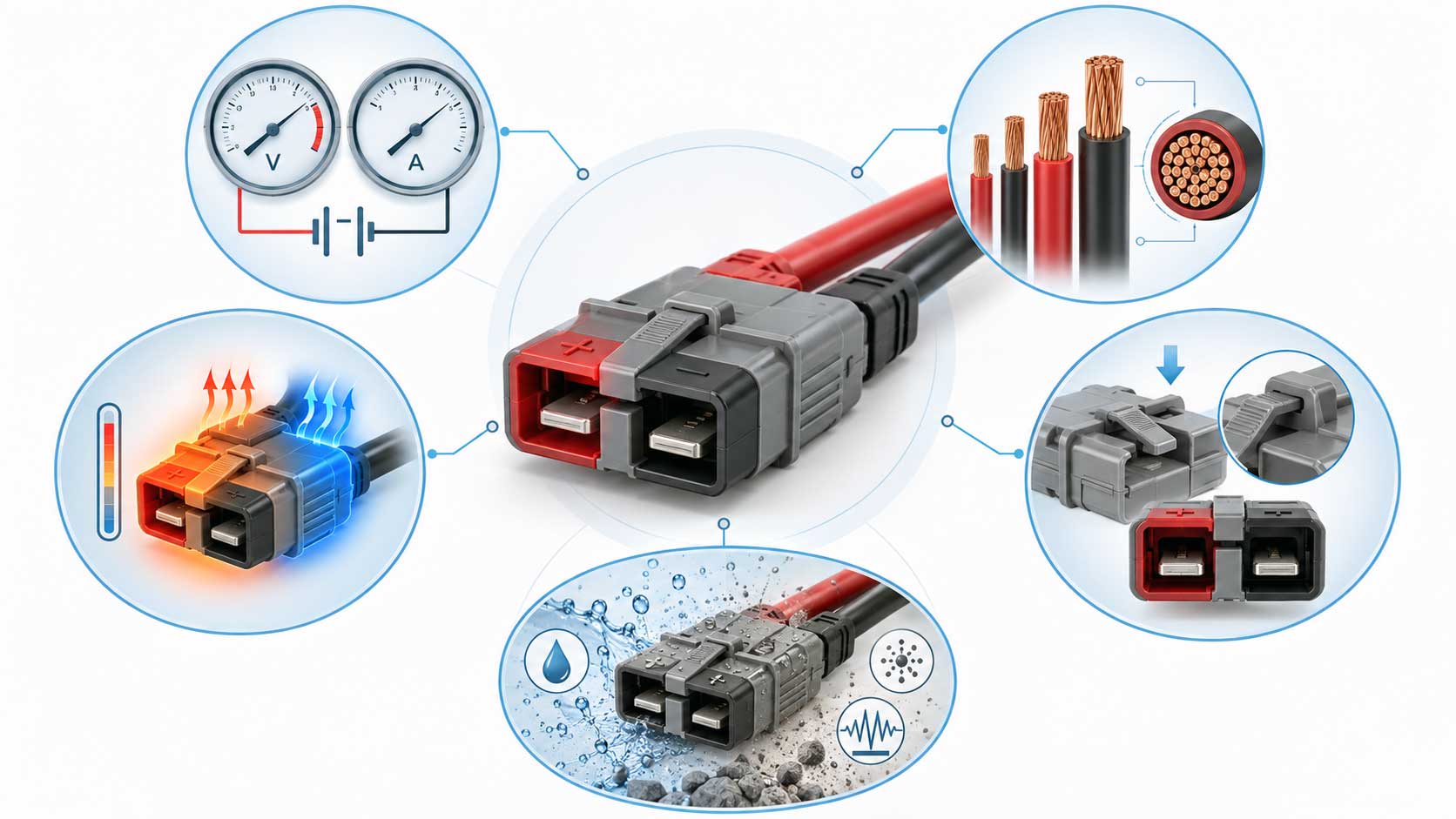
Should a Battery Connector Carry Signal Pins Too?
Modern lithium battery packs often exchange more than electrical power. Depending on the battery architecture, additional connector positions may be used for:
- NTC temperature sensing
- Battery identification
- Pack-present detection
- Communication with a battery management system
- Charging control signals
- Cell monitoring or service functions
Combining power and signal contacts in one connector can simplify assembly, but pin assignment should be carefully planned. Designers should also consider mating sequence, grounding and the consequences of partially inserted connectors.
What About Waterproof Lithium Battery Connectors?
A waterproof or sealed connector can be useful for outdoor equipment, e-bikes, cleaning machines, robotics and other applications exposed to moisture or dust.
However, the term “waterproof” should not be treated as a universal specification. A connector‘s environmental protection depends on its specific design, sealing components, mating condition and validated protection rating.
Engineers should therefore confirm the exact environmental rating and test conditions required by the application rather than relying on a general marketing description.
7 Common Lithium Battery Connector Selection Mistakes
- Choosing by appearance alone. Connectors with similar dimensions may have very different terminals and electrical specifications.
- Using nominal battery voltage instead of maximum pack voltage. Series-connected lithium-ion cells reach a higher voltage at full charge.
- Ignoring peak current. Motors and other dynamic loads can draw substantially more current during startup or acceleration.
- Assuming current ratings always add linearly. Multiple loaded contacts can influence connector temperature and may require derating.
- Using the wrong wire size for the terminal. This can compromise both electrical contact and mechanical retention.
- Ignoring vibration. A connector that works on a bench may behave differently inside moving equipment.
- Skipping real application testing. Datasheets are essential for selection, but the completed battery assembly should still be validated under realistic operating conditions.
A Practical Lithium Battery Connector Selection Checklist
| Parameter | Information to Confirm |
|---|---|
| Battery chemistry | Li-ion, Li-polymer, LiFePO4 or other system |
| Pack configuration | Number of cells in series and parallel |
| Maximum pack voltage | Voltage at full charge |
| Continuous current | Normal maximum operating current |
| Peak current | Maximum short-duration operating load |
| Charging current | Maximum expected charging current |
| Wire size | AWG or conductor cross-sectional area |
| Connector style | Wire-to-board, wire-to-wire, battery-to-board or bolted interface |
| Mating cycles | Expected number of connect/disconnect operations |
| Mechanical locking | Friction fit, latch, secondary lock or screw retention |
| Operating environment | Temperature, vibration, moisture, dust and chemical exposure |
| Signal requirements | NTC, BMS communication, identification or sensing pins |
How Should a Lithium Battery Connector Be Tested?
Connector validation should reflect the finished battery application rather than testing the connector in isolation whenever possible.
Typical engineering checks may include:
- Voltage-drop measurement under expected operating current
- Connector and terminal temperature rise
- Visual inspection of terminals and housing
- Crimp pull-force verification
- Mating and unmating force
- Repeated mating-cycle testing
- Vibration or mechanical shock testing where relevant
- Environmental exposure where required by the application
Important: Connector current capability should always be verified against the manufacturer‘s technical documentation and the actual operating conditions of the finished battery system. Generic current tables should be used only as preliminary guidance, not as a substitute for engineering validation.
Lithium Battery Connector Selection Is a System Decision
The best lithium battery connector is not necessarily the smallest, largest or highest-current model available. It is the one that fits the complete electrical and mechanical design.
A good selection process considers the battery pack, BMS, cable, connector, PCB, charger and load as parts of the same system.
When current capacity, wire size, contact resistance, thermal behavior, locking, polarization and environmental conditions are considered together, connector selection becomes more predictable—and problems are much easier to prevent before production.
Lithium Battery Connector FAQ
What connector is used for a lithium battery?
Lithium batteries can use many different connectors. The correct type depends on pack voltage, continuous and peak current, wire size, mechanical space, mating frequency and environmental requirements. There is no universal lithium battery connector for every application.
How do I choose a lithium battery connector current rating?
Determine the maximum continuous current, peak current and charging current first. Then compare these requirements with the connector manufacturer‘s ratings, including specified wire size, ambient temperature and any required derating.
Can I use a connector rated exactly at my battery‘s maximum current?
It is better to evaluate the complete operating conditions rather than relying only on a nominal rating. Ambient temperature, loaded contacts, cable size, ventilation and connector condition may all affect thermal performance.
Why does a lithium battery connector become hot?
Heating can result from high current, increased contact resistance, poor crimping, loose mating, contamination, damaged terminals, undersized wiring or operation beyond the connector‘s intended conditions. The root cause should be investigated before continued use.
Is a locking connector necessary for lithium batteries?
Not always. However, positive locking is useful in applications exposed to vibration, movement, cable pulling or frequent servicing because it reduces the risk of unintended disconnection.
Can one connector carry battery power and BMS signals?
Yes. Multi-pin battery connectors can combine power, ground, temperature sensing and communication contacts. Pin assignment, contact ratings and mating behavior should be considered carefully during system design.
Does a lower contact resistance always mean a better connector?
Low contact resistance is desirable for power transmission, but it is only one selection factor. Mechanical retention, temperature rating, conductor compatibility, environmental resistance, size and mating life also influence connector suitability.
Need Help Matching a Lithium Battery Connector to Your Battery Pack?
Connector selection becomes much easier when the electrical and mechanical requirements are defined early in the battery design process.
For a battery pack project, useful information normally includes: battery chemistry, series/parallel configuration, maximum voltage, continuous current, peak current, charging current, wire gauge, connector space, number of contacts and expected operating environment.
With these parameters, a battery supplier or engineering team can evaluate suitable connector options together with cable size, BMS design and pack construction rather than treating the connector as an isolated component.
A reliable battery connection starts with the right specification—not simply the right plug shape.